Vocci Ring Review (2026): The First AI Note-Taking Ring, Honestly Weighed
CES 2026’s titanium AI ring shipped in August and nobody has independently reviewed it. We assembled what is verified — specs, plan math, the ring-vs-card trade-offs — and what is still promise.
On this page
The short answer
The world’s first AI note-taking ring is real, shipping, and honest about its limits
Verdict: the $249 Vocci Ring (titanium surfaces, 3–5 g, IP67) is the first meeting recorder you actually wear as a ring — and after a CES 2026 debut and an August general release, it is shipping today with a genuinely free 300-minute tier. The catches are the honest ones: one microphone and a 5-meter range put it closer to a personal-capture device than a room recorder, 8 hours of continuous capture trails the card leaders, and zero independent reviews exist yet — this page tracks what is verified versus promised. Buy it for discretion and all-day wear; buy a PLAUD for rooms.
See the Vocci Ring at vocci.aiSponsored link · We may earn a commission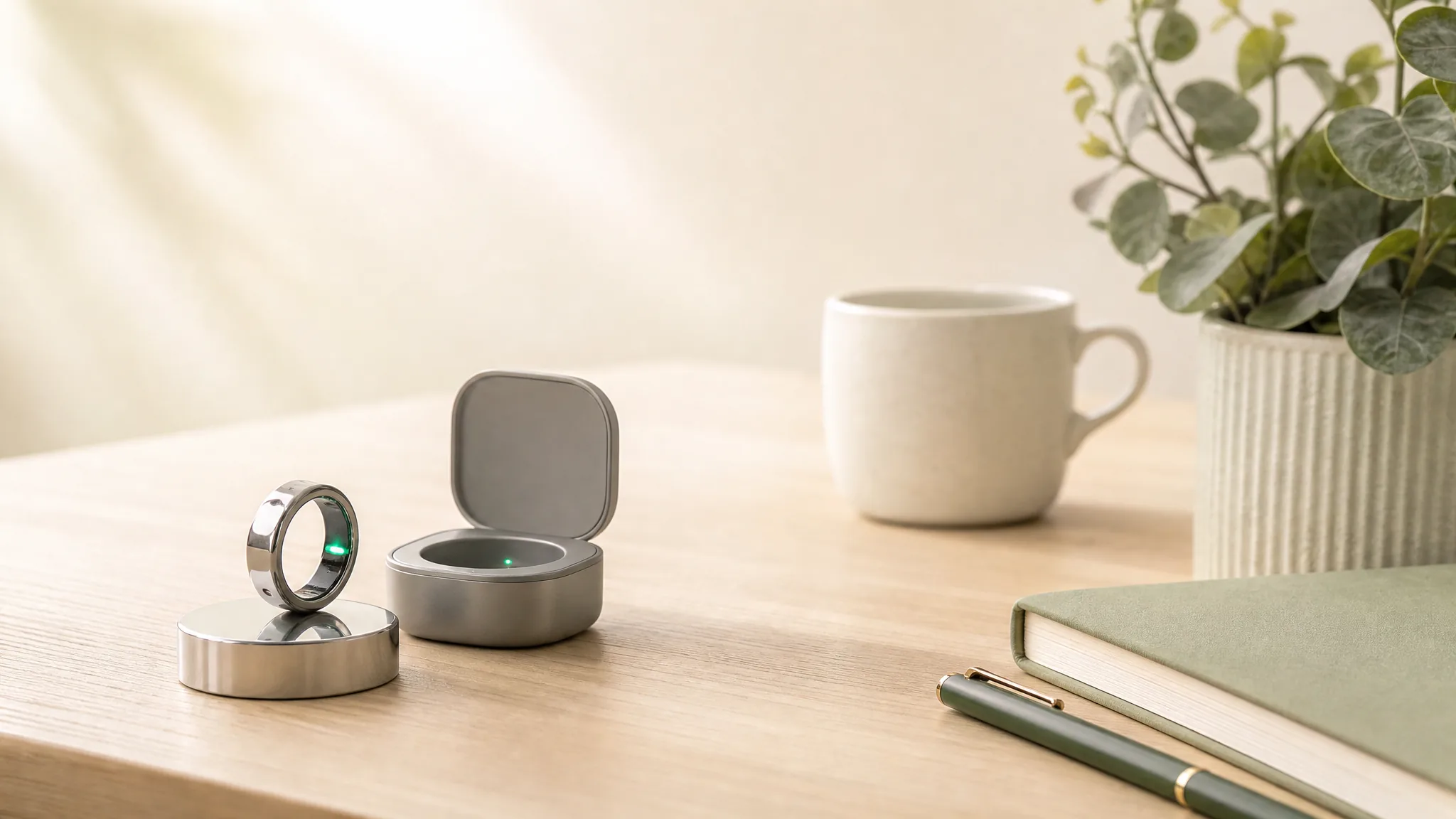 Illustrative — not the actual product
What the Vocci Ring is
Vocci launched the AI Context Ring at CES 2026 to broad press attention — CNET called it “this tiny titanium smart ring… actually a powerful AI meeting recorder” (Jan 9, 2026), with Engadget, Digital Trends, Forbes, and Tech Advisor all filing from the show floor. General availability opened August 4, 2026 (Yahoo Finance). It is a smart ring that records conversations on a double-click of its button, transcribes them in the app, and layers AI summaries, speaker labels, and an agent on top — while explicitly refusing the health tracking every other smart ring sells. Forbes’ headline captured the positioning: “This AI Ring Ditches Health Tracking To Be A Voice Recorder.”
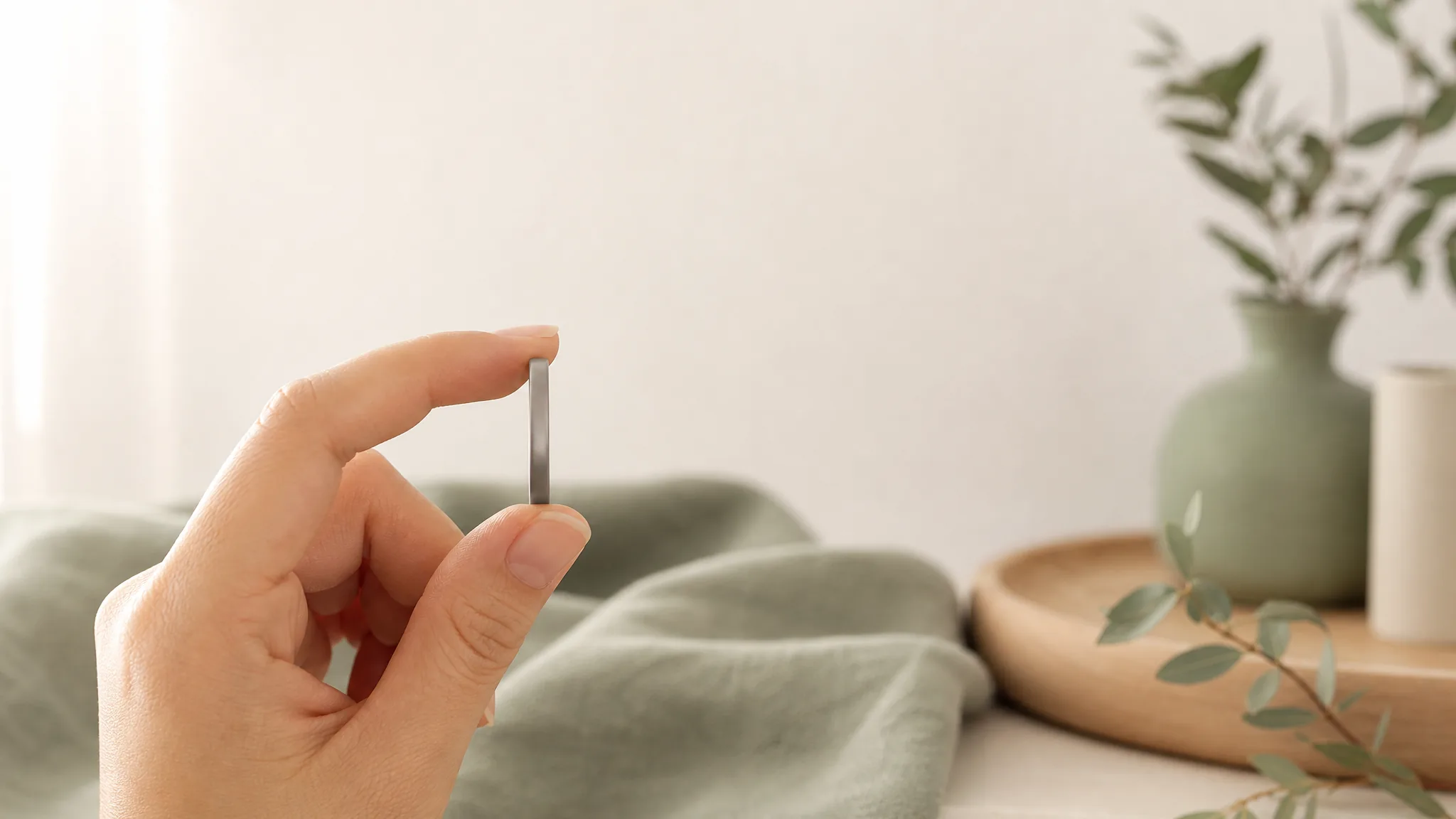
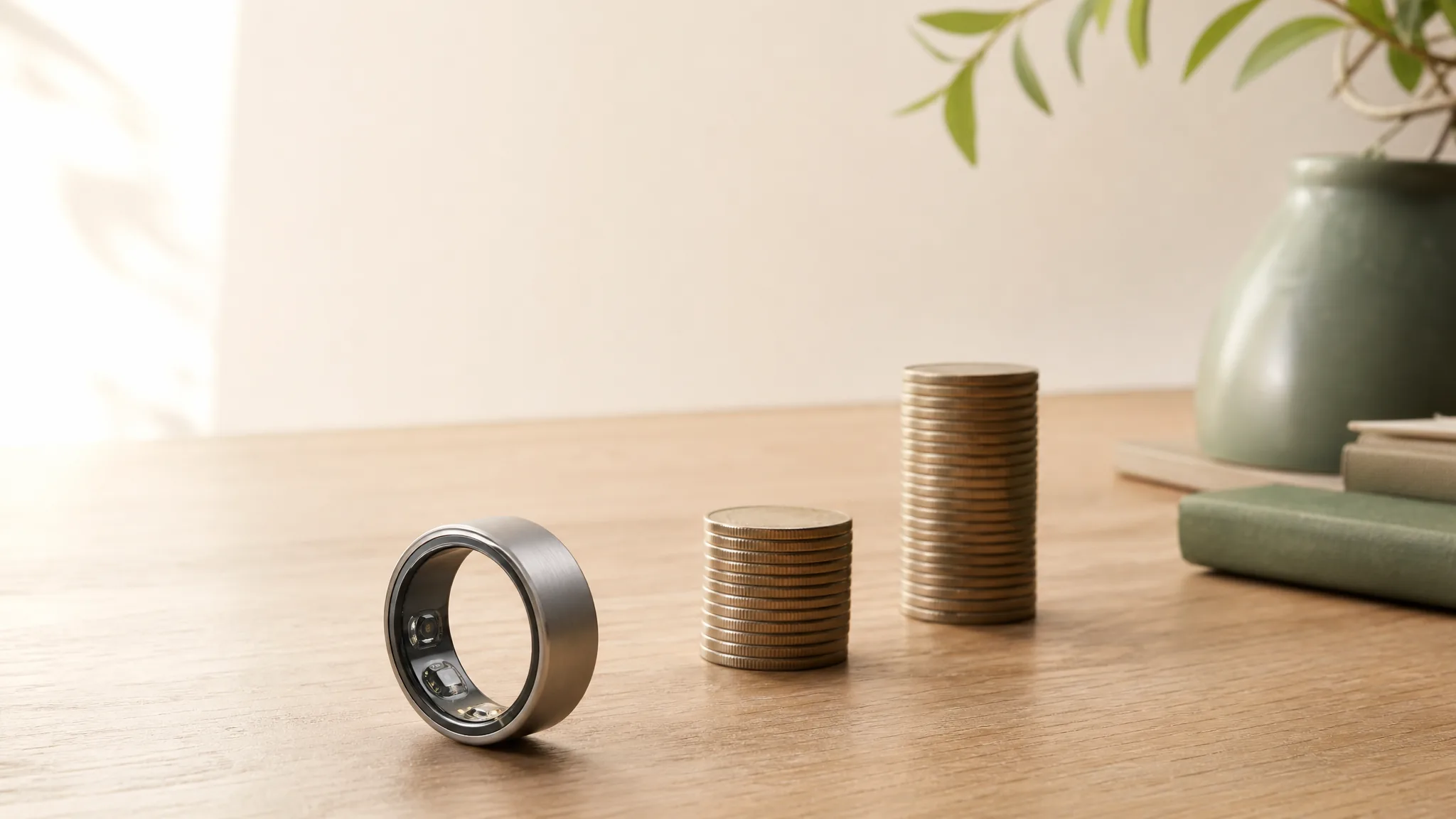
The pitch is discretion. At 6.8 mm wide, 2.85 mm thick, and 3–5 grams with titanium on the inner and outer surfaces, it looks like jewelry and weighs less than a nickel. Recording starts with a double-click; a haptic pulse and a subtle LED glow confirm it’s live [SPEC]. For anyone who has felt the social weight of clipping a PLAUD to their lapel, that is the entire product thesis.
Spec snapshot
| Spec | Claimed / observed |
|---|---|
| Form factor | Ring, US sizes 6–15; free sizing kit ships in 24 hours [SPEC] (vocci.ai, Oct 2026) |
| Price | $249 (compare-at $299); Lux finish $299/$399; $25 off each on 2+ rings [SPEC] (vocci.ai Shopify, Oct 2026) |
| Materials | Titanium inner & outer surfaces; 6.8 mm wide, 2.85 mm thick, 3–5 g [SPEC] |
| Water/dust | IP67 [SPEC] |
| Battery | Up to 8 hrs continuous recording; ~2 days regular use [SPEC] |
| Charging | Magnetic; 80% in 30 minutes; case holds 3 extra full charges [SPEC] |
| Microphone | 1 MEMS; effective range up to 5 m [SPEC] |
| Storage | On-device, capacity not published in GB; case included [SPEC] |
| Connectivity | BLE 5.4; iOS & Android apps [SPEC] |
| Free tier | Starter $0/mo: 300 transcription min/mo, 30 AI-agent uses, 2 GB cloud [SPEC] |
| Paid plans | Plus $15.99/mo (1,200 min, 10 GB); Pro $29.99/mo (unlimited min, 20 GB, 300 agent uses) [SPEC] |
| Support | 14-day returns; 1-year warranty [SPEC] |
 Illustrative — not the actual product
The ring trade-offs, honestly weighed
The ring form factor buys discretion but spends battery, audio reach, and microphone count. Compare it against the wearable incumbents in our wearable guide:
| Dimension | Vocci Ring | Typical pendant (Omi, NotePin) | Typical card (PLAUD Note) |
|---|---|---|---|
| Discretion | Highest — reads as jewelry | High — small pendant on a chain | Moderate — visible card or phone case |
| Mic reach | Up to 5 m, 1 MEMS [SPEC] | ~3–4 m typical | Up to ~5 m (Note Pro claims 16.4 ft w/ 4 MEMS + VPU) [SPEC] |
| Battery (continuous) | 8 hrs [SPEC] | 20–30 hrs typical | ~30 hrs (Note), 50 hrs (Note Pro) [SPEC] |
| All-day comfort | Excellent — worn like any ring | Good | Pocket/case carry |
| Health tracking | None — voice only by design | Omi offers some | None |
That table is the buying decision in miniature. If your recordings happen at your own desk, in 1:1s, or on calls where you’re a party — the Ring’s 5-meter, single-mic envelope is sufficient and the form factor wins. If you record conference rooms, lectures, or depositions, the mic count and battery of a card win — our card-vs-wearable breakdown runs the full decision tree.
Why this review exists now
Two signals say interest is compounding. First, Japan: Vocci opened GREEN FUNDING crowdfunding on Sep 30, 2026 and hit its goal in 20 minutes, topping $33K (Dealroom, Oct 2) — following an ASCII.jp-documented retail launch there on Sep 25. Second, the review vacuum: Google News shows CES news, a TechCrunch launch piece, and a May TechRadar column that is explicitly an opinion (“may be the first AI wearable I do not hate”), not a verdict. TechRepublic’s Oct 6 roundup of the category mentions Vocci without testing it. No major outlet has published a dedicated review of shipping hardware — which is why this page exists, and why it is structured as evidence synthesis rather than hands-on verdict.
The plan math
The free tier is genuinely usable: 300 transcription minutes a month with auto-transcribe, AI summaries, speaker labels, and raw-audio export included [SPEC]. That is the same free lane PLAUD offers — and unlike the early days of the category, you can outgrow it for $15.99/mo instead of being pushed straight to a $99.99/yr commitment. One unusual escape hatch: Vocci says users can export raw audio via MCP and run their own local speech-to-text without any subscription [SPEC] — the tinkerer’s route to unlimited free transcription, and the subject of our exports guide.
| Scenario | 3-year total |
|---|---|
| Within the free 300 min/mo | $249 (hardware only) |
| Plus plan, every month | $249 + 36×$15.99 = $824.64 |
| Pro plan, every month | $249 + 36×$29.99 = $1,328.64 |
| Compare: PLAUD Note within free tier | $129–$159 [EDIT TCO study] |
Run your own numbers in our minutes calculator before subscribing — 300 minutes is roughly 8–10 hour-long conversations a month, which covers most 1:1-heavy professionals.
 Illustrative — not the actual product
Privacy, consent, and the MCP route
A ring is the most personal recording form factor yet — and the most likely to be worn into conversations where recording wasn’t announced. Our consent-laws guide covers the state-by-state rules; the practical rule for any wearable is simpler: the smaller the device, the more discipline the wearer owes it. Vocci’s MCP export path also matters here — if raw audio can be pulled locally and processed by your own ASR, sensitive conversations need never touch Vocci’s cloud at all [SPEC]. That is a real differentiator against app-locked rivals, and we will verify it against shipping firmware as reports emerge.
Who should buy it — and who should wait
Buy it if: you want the most discreet capture device made, your recordings are 1:1s, desk calls, and personal notes within arm’s reach, and the free 300-minute tier matches your volume. The titanium build, sizing kit, and 14-day return make the commitment low-risk to try.
Wait if: you record rooms, lectures, or meetings where you’re not a party — one microphone and 5 meters is the wrong instrument. Wait also if you want an independent verdict on audio quality: none exists yet, and the first shipping units only started reaching buyers in August. Our PLAUD Note review remains the default recommendation for general-purpose recording.
We will update this page as owner reports accumulate — the same way our Vibe Dot review tracks its own pre-order wait.