On this page
AI Transcription Accuracy Claims vs Reality: What 98% Actually Means
The short answer: PLAUD claims 98%, Soundcore claims "up to 97%", NOTTA claims "up to 98%" — and none of those numbers are comparable, because no maker publishes a test set or a methodology. Accuracy is real but oversold: mic distance, room noise, and accents move your transcript more than the brand on the box. Here's the claims table, why the numbers don't stack, and what to actually buy on.
The claims
The claims, side by side
Every figure below is the maker's own marketing claim, quoted and attributed. The right-hand column is the honest part: what each maker publishes to back the number up.
| Maker / product | Claim (quoted) | What's actually tested |
|---|---|---|
| PLAUD (Note family) | "98% accuracy" — PLAUD marketing | Nothing published. No test set, no methodology, no definition of "accuracy." |
| Soundcore Work | "up to 97%" — Anker marketing, citing GPT-4o transcribe tech | Nothing published. The claim cites the underlying model, not a measured result on the device. |
| NOTTA Memo | "up to 98% with clear audio" — NOTTA marketing | Nothing published. The qualifier ("with clear audio") is doing the heavy lifting. |
All three claims verified against maker marketing materials, 2026-09-06. The "what's actually tested" column is the finding, not an accusation: we searched for published methodologies and found none. That absence is itself the story.
The tell is in the qualifiers. "Up to" and "with clear audio" are escape hatches — they let the claim stand while excusing every real-world recording where conditions aren't ideal. A number that only applies in the best case, under conditions the maker doesn't define, isn't a specification. It's an aspiration.
---
Guide
Why the numbers aren't comparable
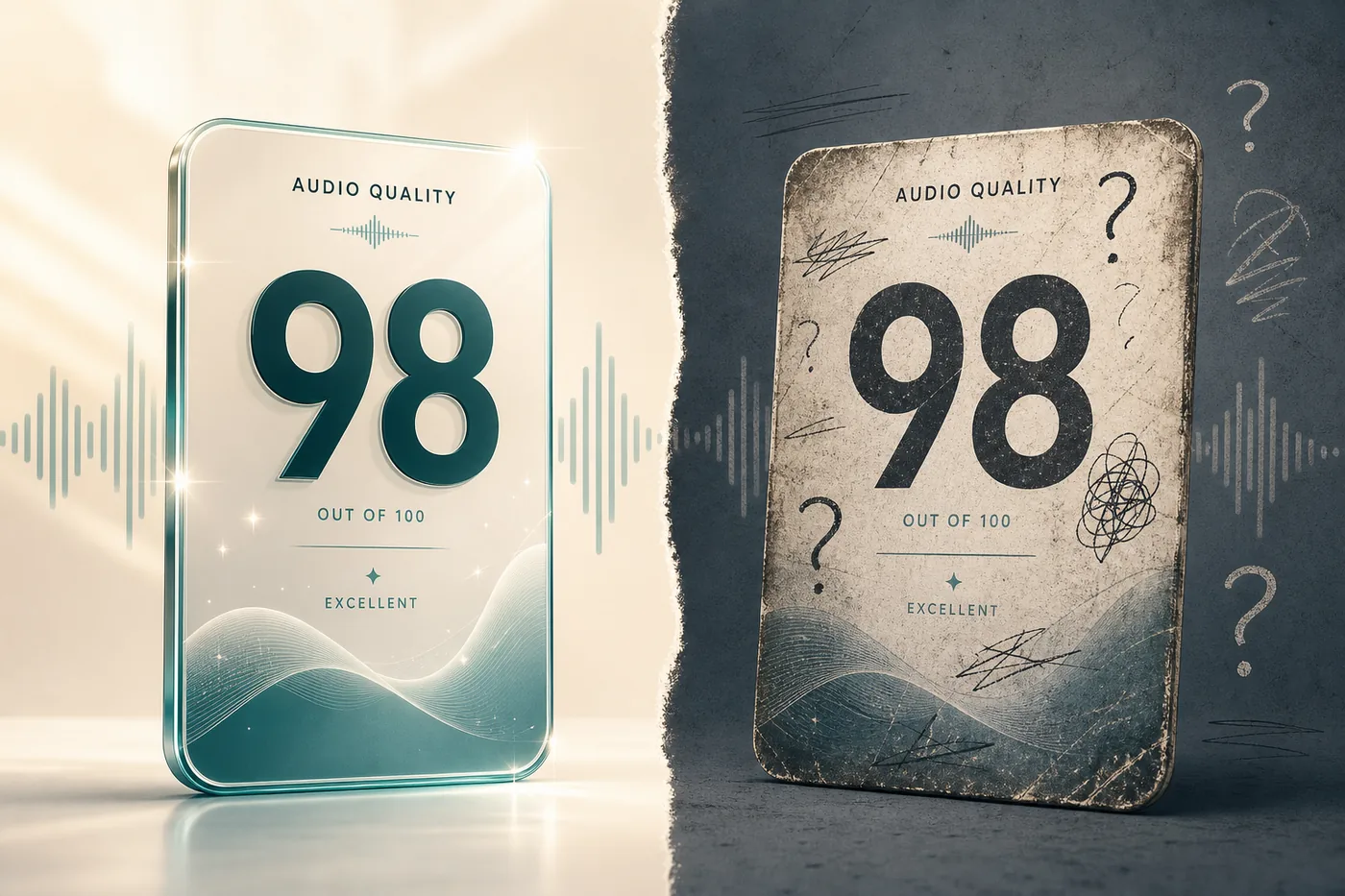
No shared test set. A meaningful accuracy comparison requires the same audio run through every system: same speakers, same noise, same scoring method. None of that exists here. Each maker grades its own homework on audio it chose, using a definition of "accuracy" (word error rate? keyword recall? "close enough"?) it never publishes.
One percentage point of marketing is not one point of performance. If PLAUD's 98% and Soundcore's "up to 97%" were measured on the same recordings with the same scoring, one point might mean something. Measured on different audio with different scoring, the gap is noise. Two vendors could swap numbers tomorrow and nothing observable would change.
The claims measure different things even when the words match. Soundcore's figure is anchored to GPT-4o transcribe tech — a claim about the model class doing the transcription. NOTTA's is anchored to audio conditions. PLAUD's is unqualified in the marketing we reviewed but unanchored to any method. These aren't three readings of one ruler; they're three different rulers.
Honest limit: no independent benchmark of these devices' transcription engines was found in the research behind this page. The reasoning here is editorial inference from the claims' structure and the absence of published methodology — not a third-party measurement. For how we handle maker claims across the site, see our review methodology.
What a real benchmark would look like. For these numbers to mean anything, a maker would need to publish three things: the test set (which recordings, how recorded), the scoring method (word error rate? keyword recall? human judgment?), and a per-condition breakdown (quiet room vs café, near mic vs far). None of the three makers publishes any of the three. Until one does, every accuracy figure in this category is a marketing number wearing a measurement's clothes.
---
<
Guide
What actually moves accuracy
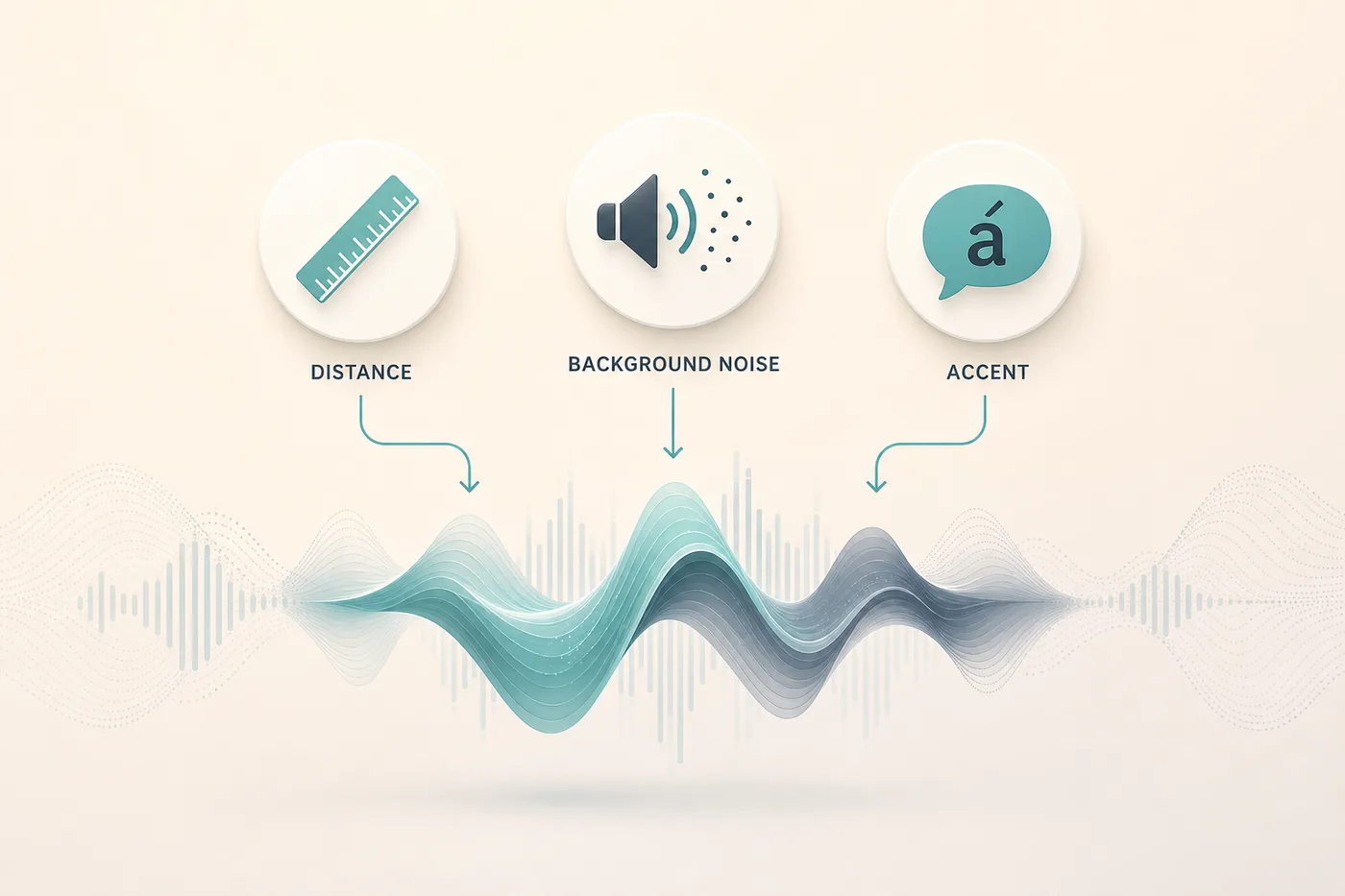
Owner reports converge on four variables, and none of them is the brand on the box.
Mic distance. PLAUD's own lecture-capture blog states the "pickup range stays at 2 to 3 meters in quiet rooms" — a maker's own admission that its hardware has a distance ceiling, published in the same marketing universe as the 98% claim. Past that range, in a lecture hall or a large conference room, the recorder hears room tone before it hears the speaker, and no transcription model can transcribe audio it never received. Sit closer than you think you need to, or use a device you can place at the source — our best AI recorders for lectures guide ranks options built for exactly this. We tabulate published distance claims across devices in the sibling AI recorder mic distance claims table. PLAUD lecture blog, retrieved 2026-09-06.
Background noise. Cafés, open-plan offices, and traffic are the standard failure cases in owner reports. Noise doesn't just mask words — it forces the model to guess, and models guess plausibly, which is worse than an obvious gap because you can't see it. The NOTTA qualifier "with clear audio" is the industry quietly admitting this. For noisy environments, capture method (a phone's beamforming mics, a dedicated mic at the speaker) matters more than the recorder's brand.
Accent and vocabulary. Transcription models are trained predominantly on mainstream-accented speech; owners with strong regional accents, non-native speakers, and specialized-domain recordings (law, medicine, engineering) report the largest gaps between claimed and experienced accuracy. Domain jargon compounds this — the model hears a plausible near-word instead of your term of art. Glossary and custom-vocabulary features (documented on PLAUD, among others) exist precisely because this is a known weakness. Language support compounds it: PLAUD devices handle a single language per recording, so a conversation that switches languages mid-stream sits outside any accuracy claim entirely — see AI recorder language support.
Speaker separation. Multi-speaker meetings are a different task from transcription: the model must segment who said what before it can transcribe it. Owner reports of "mixed-up" meeting transcripts usually trace to separation failing — crosstalk, similar voices, or speakers at very different distances — not to word-level accuracy failing. A transcript that attributes your sentence to the wrong colleague is 98% accurate by word count and useless in practice.
The pattern: every one of these variables is about the recording conditions, not the device's chip. That's why the headline numbers feel both true (in the maker's best-case audio) and wrong (in your meeting room) at the same time.
Run the claim through four questions before letting it influence a purchase:
- Is there a test set? If the maker doesn't say which recordings produced the number, the number is unfalsifiable.
- Is there a methodology? No published scoring method means no way to compare against any other maker's figure.
- What are the qualifiers? "Up to," "with clear audio," "in quiet environments" — every qualifier is a condition the maker reserves the right to require.
- Does the claim survive the maker's own specs? PLAUD's 98% sits alongside its own 2–3 meter pickup-range admission — when a maker's own materials bound the claim, believe the bound.
A claim that fails all four isn't false; it's uninformative. Buy on other grounds.
---
<
Honest buying advice
Honest buying advice
Choose on the things makers don't put in a headline:
- Ecosystem fit. Where do your transcripts need to live — the maker's app, your notes tool, your team's workspace? Export paths and integrations differ far more than claimed accuracy does, and the local vs cloud transcription trade-offs belong in this decision too.
- Plan fit. The transcription is often the free part; the monthly fee buys summary minutes, AI features, and upload limits. Match the plan structure to your monthly volume before caring about a percentage point.
- Capture method. A recorder you can place at the speaker, or a wearable positioned near your voice, beats a distant table mic from any brand. This single decision moves real-world accuracy more than any maker's claim.
Treat accuracy deltas between devices as tie-breakers — and treat even those skeptically, given the numbers aren't comparable. If a maker ever publishes a test set and methodology, that will be worth more than any percentage point. Until then, the honest default is: buy for the workflow, control the recording conditions, and expect the transcript to be only as good as the audio.
Quick screen — red flags vs green flags. Red flags: a bare percentage with no methodology; accuracy used as the lead differentiator in marketing; "up to" doing load-bearing work. Green flags: published pickup-range or distance specs (honest hardware limits); glossary/custom-vocabulary support (acknowledges a real weakness); plan structures you can actually match to your volume. The green flags tell you a maker is being precise somewhere — which is a better trust signal than a precise-sounding percentage.
If you've settled on workflow over percentages, the field is worth browsing on price and plan fit rather than claims.
---
Per-family verdicts
Per-family verdicts
PLAUD (Note family). The "98% accuracy" claim is unqualified marketing with no published methodology, and PLAUD's own lecture blog concedes a 2–3 meter pickup range in quiet rooms — the maker's own materials bounding its own claim. PLAUD's real strengths are the template/summary ecosystem and form factor, not a provable accuracy edge. For the summary-quality problems specific to PLAUD — including the "word vomit" template issue — see our PLAUD Template Accuracy deep-dive.
Soundcore Work. "Up to 97%" citing GPT-4o transcribe tech is a claim about the model class, not a device measurement — and "up to" means the ceiling, not the floor. The honest reading: a capable modern engine whose real-world results will track your audio conditions like everyone else's.
NOTTA Memo. "Up to 98% with clear audio" is the most honest of the three claims, because it admits its own condition. It's also the least useful as a buying signal, since it promises nothing about the unclear audio you'll actually record.
The field. Every maker lands in the same 97–98% band because the band is marketing gravity, not measurement. When everyone claims the same number, the number carries no information — the differentiators are ecosystem, plans, and capture.
---
FAQ
Frequently asked questions
Why do all AI recorders claim 97–98% accuracy?
Is PLAUD’s 98% accuracy claim verifiable?
What actually improves transcription accuracy?
Does Soundcore Work’s 97% claim make it less accurate than PLAUD?
Should accuracy claims affect which recorder I buy?
Keep reading
PLAUD template accuracy, measured
Our PLAUD-specific deep-dive: the marketing-vs-experience gap.
Local vs cloud transcription
Where the audio goes and what that means for accuracy.
How we review: the methodology
Why we cite owner reports instead of lab claims.