On this page
If you searched for “TicNote review” and landed here, you have already noticed something odd: nearly everything that ranks is written by TicNote’s parent company. Mobvoi publishes the product pages, its own comparison posts, and the app-store presence — while independent outlets have barely touched the device. That is exactly why this page exists. This is our evidence synthesis: what the manufacturer claims [SPEC], what the numbers in our total-cost-of-ownership study say, and a plain account of what nobody can honestly tell you yet.
 Card recorder illustration
The short answer
Best value in the category on our dataset — if you accept a young ecosystem and cloud-only transcription
Verdict: the best value on our dataset — 600 included minutes a month and the cheapest paid plan ($79/yr; $336 over three years) — if you accept a young ecosystem and cloud-only transcription. The verification gaps below are about everything except the math.
See TicNote options on Amazon · Paid linkPaid link · As an Amazon Associate we earn from qualifying purchases · How we are paid600 min/mo free transcription — largest tier we track
$79/yr Pro — cheapest paid plan in the category
$336 3-year total at the low end of street pricing
VS PLAUD 600 vs 300 free min; $79 vs $99.99 Pro
Specs
TicNote at a glance: what the specs claim
Everything below is what the manufacturer publishes [SPEC] — ticnote.ai’s product page and Mobvoi’s TicNote page (retrieved September 4, 2026) — plus our August 2026 editorial price research. No figure here comes from hands-on testing, and none of it is independently verified yet.
| Spec | What is claimed / observed |
|---|---|
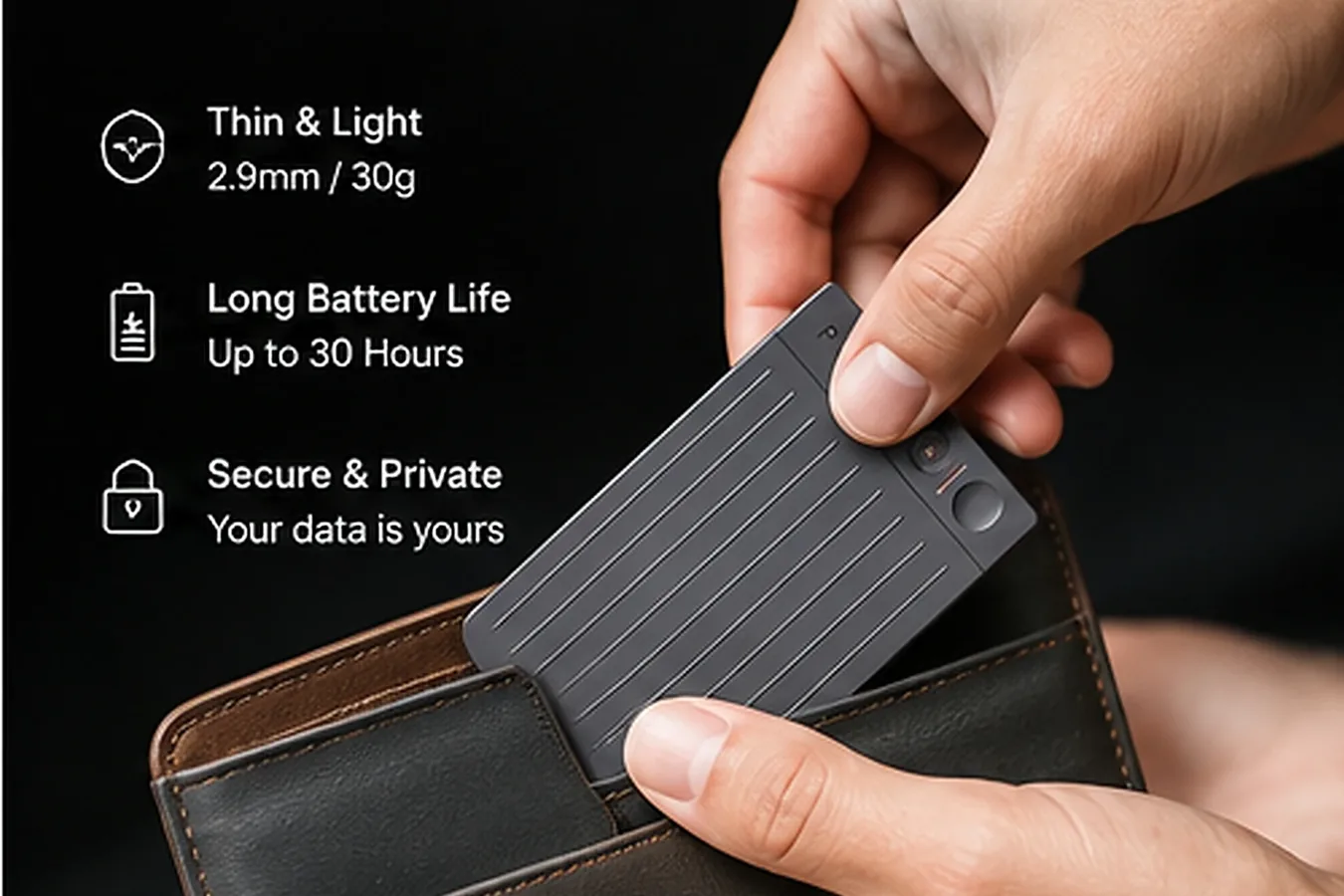
| Form factor | Credit-card-sized magnetic recorder, 29 g, aluminum case, OLED display [SPEC] |
| Street price (editorial, Aug 2026) | $99–$160 observed across listings; ticnote.ai lists the card at $139.99 with a $179.99 compare-at price [SPEC] |
| Free transcription | 600 min/mo for eligible hardware-bound accounts — the largest free tier we track; unbound free accounts get 300 min/mo [SPEC] |
| Cheapest paid plan | Pro at $79/yr for 2,100 min/mo on our dataset — the cheapest paid plan in the category [SPEC] |
| 3-year total | $336 at the low end of street pricing ($99 + 3 × $79), per our TCO study |
| Phone-call capture | Placement-only: vibration-based phone-call recording when the card is mounted against the phone [SPEC] |
| Battery | 470 mAh, ~25 hrs continuous recording, 20+ days standby, 1.5 hr charge [SPEC] |
| Warranty | 1 year from receipt [SPEC] (ticnote.ai, Sep 2026) |
| Storage | 64 GB (≈434 hrs of recording) plus unlimited encrypted cloud storage [SPEC] |
| Transcription | Cloud-only — 120+ languages claimed, real-time transcription, 98% accuracy claimed [SPEC] |
| Mics / quality | 3 MEMS microphones, 1536 kbps, 10 m recording range, noise-reduction MOS 3.5–4.2 (claimed) [SPEC] |
| Extra AI features | Summaries, mind maps, speaker identification, Shadow AI chat, photo notes — all cloud-based [SPEC] |
Follow the money
The value math vs PLAUD
TicNote’s value case is a numbers race, and it wins on every line against the category’s default comparison — the PLAUD Note. The frame matters: two card recorders, similar hardware stories (magnetic card, app transcription, metered minutes), very different economics.
| Line | TicNote | PLAUD Note |
|---|---|---|
| Free transcription | 600 min/mo [SPEC] | 300 min/mo [SPEC] |
| Cheapest paid plan | Pro $79/yr — 2,100 min/mo [SPEC] | Pro $99.99/yr — 1,200 min/mo [SPEC] |
| Hardware (low end) | $99–$160 street | $129–$159 street |
| 3-year total (Pro, low-end hardware) | $336 | $428.97 |
| Live on-screen transcription | Claimed [SPEC] | Not offered [SPEC] |
| Phone-call capture | Placement-only, vibration sensor [SPEC] | True call capture via MagSafe-style case [SPEC] |
How the Note compares on the same math: TicNote vs PLAUD Note — the head-to-head.
The math in plain terms:
- Free tier: 600 vs 300 minutes a month doubles the runway before you pay anything. For a student recording 5–10 lecture hours a month, the free tier covers a typical course load with room to spare.
- Paid tier: $79/yr vs $99.99/yr — a larger allowance on our dataset (2,100 vs 1,200 min/mo) for about 21% less per year, and the cheapest paid plan in the category.
- Three-year total: $336 vs $428.97 at the low end of hardware pricing — roughly $93 less over three years, or about 22% cheaper, before any PLAUD discounting.
Why the gap is so wide: PLAUD’s value lives in its ecosystem — proven call capture, Notion/Zapier/ChatGPT integrations, deeper retail presence — while TicNote undercuts on every cost line to buy its way into the category. That is a real trade, not a free win, and it is the subject of the next two sections. The full tier-by-tier economics are in our best AI recorders guide and the TCO study.
Honesty section
What we know and what nobody knows yet
This is the section almost no review page writes, and it is the reason you should read this one before spending money.
Pro allowance: our dataset carries 2,100 min/mo, but TicNote does not publish the Pro allowance on its own pages as of September 2026 — only the 600-minute free tier is published. The figure is flagged for vendor confirmation and will be corrected here if it differs.
What the manufacturer specs claim [SPEC]: 600 free minutes a month for hardware-bound accounts (300 for unbound), Pro at $79/yr on our dataset, a 470 mAh battery with ~25 hours of continuous recording and 20+ days standby, 64 GB storage — roughly 434 hours at the recorded bitrate — 3 MEMS microphones with a claimed 98% accuracy and 120+ languages, live on-screen transcription, summaries and mind maps, and placement-only phone-call capture via a vibration sensor. Mobvoi additionally claims its cloud infrastructure is US-based and that your data is not used to train AI models [SPEC]. All of that is manufacturer-supplied; we can verify it is published, and nothing more.
What nobody can honestly confirm yet: real-world accuracy at the claimed 98%, call-capture reliability across iPhone and Android, battery life in daily mixed use, the durability of the magnetic mounting, long-term app polish, and what the subscription ecosystem will look like in two years. Owner reports at meaningful volume have not had time to accumulate. On our review methodology, that means the honest label for this page is evidence synthesis with a wide unknown column — exactly what you see here. Treat any YouTuber or forum verdict claiming deep, long-term TicNote experience with the same skepticism you would apply to a brand’s own marketing.
The trade-offs
Where TicNote’s value comes with compromises
The economics above are real, and so are the trade-offs. Three stand out for buyers comparing TicNote against the card category.
1 · Calls
Placement-only call capture. TicNote records phone calls via a vibration sensor with the card mounted against the phone [SPEC]. Useful — real call capture does exist in the category (PLAUD’s case is the proven example) — but only if you are willing to physically attach the card during a call. Our phone-call recording guide covers the difference and its compliance implications.
2 · Battery
~25 hours continuous, 470 mAh [SPEC]. Plenty for a day of lectures or meetings — but noticeably behind PLAUD’s claimed 30 hours and far behind dedicated field recorders. If your recording days routinely run past 25 hours of continuous use, check the lecture recorder guide before committing.
3 · Cloud-only
No offline transcription. Every transcript, summary, and search result comes from TicNote’s cloud [SPEC]. That means your audio leaves the device, and if the service changes terms or goes away, the workflow changes with it. The local vs cloud guide compares this against on-device options like iFLYTEK.
Two more context points. Storage is not the risk it can be elsewhere — 64 GB is generous — but the recorder is bound to its app, so feature availability and pricing are the manufacturer’s to change. And the display is a small OLED for status, not an InstantView-style dashboard. All of this is a fair exchange for the price; the point is to know what you are exchanging.
The verdict
Who should buy TicNote — and who should skip it
Buy TicNote if
- Your usage fits ~600 free minutes a month — students and many light professionals never pay a cent [SPEC]
- You are willing to verify specs against the product yourself — no independent benchmark exists yet
- Live on-screen transcription while you record is a workflow win — PLAUD only processes after you stop [SPEC]
- Three-year cost is your dominant decision factor — $336 beats every paid-plan rival we track
Skip TicNote if
- Your phone calls are the main use case — placement-only capture is not true call recording [SPEC]
- Your audio cannot touch a cloud — TicNote has no offline mode; look at no-subscription or offline devices
- You want a proven integration ecosystem (Notion, Zapier, ChatGPT) out of the box — PLAUD’s is deeper and more documented
- You need verified, long-term owner sentiment before buying — that simply does not exist for this device yet
Still deciding between the card and its closest rival? Our TicNote vs PLAUD Note comparison walks through the call-capture and subscription differences in detail. And if the biggest barrier to buying is that nothing independent has reviewed it, keep an eye on the methodology page — we will update this review the moment credible independent coverage exists to synthesize.
Ownership costs & care
Warranty. 1 year from receipt, per TicNote’s own warranty policy (ticnote.ai, retrieved Sep 2026) [SPEC] — covers defects in materials and workmanship for the original purchaser.
Charging habit. The 470 mAh cell charges in about 1.5 hours and is rated ~25 hours continuous / 20+ days standby [SPEC] — a weekly charge covers most lecture and meeting loads.
Known unknowns. Long-term durability of the magnetic mounting is not yet documented in independent or owner reports as of Sep 2026 — treat it as unproven, not defective.
No recurring maintenance pattern appears in the owner reports we tracked as of Sep 2026.
FAQ
Frequently asked questions
Does TicNote capture phone calls?
How much does TicNote cost over three years?
Do I need a subscription to use TicNote?
What does TicNote’s free tier cover?
Is TicNote transcription accurate?
Still fits your use case after the FAQ?
See TicNote options on Amazon · Paid linkPaid link · As an Amazon Associate we earn from qualifying purchases · How we are paid