On this page
Is the PLAUD Note Worth It?
The short version
The 50-word verdict
The PLAUD Note is worth it if your month fits inside its 300 free transcription minutes — roughly five hours of meetings. It is not worth it if you transcribe more, because the paid plan doubles the cost. Light users should consider a cheaper card; privacy-first buyers look at offline options.
The details
The short math
The whole "is it worth it" question reduces to one number: how many transcription minutes you actually use in a month. The Note's free Starter tier includes 300 minutes a month — that is roughly five hours of recorded and transcribed audio. Recording itself is unlimited; it is the transcription that the allowance meters. If your month stays under that line, the Note is effectively a one-time hardware purchase and the value is excellent.
The paid Pro plan raises the allowance to 1,200 minutes a month — about twenty hours — for an annual fee. That is the point where the Note stops being a cheap recorder and becomes a subscription product. A week of hour-long meetings uses roughly 250 minutes, so a meetings-heavy professional exhausts the free tier in week one and lives on Pro thereafter. The honest way to decide is to measure your real month before you buy, not to guess — our transcription minutes calculator turns your actual calendar into a monthly total you can compare against the free tier.
The distinction between the two tiers is worth spelling out because it drives the entire value verdict. On the free tier, the Note is a genuinely cheap way into the category: you pay for the hardware once and the transcription is included. On the Pro tier, the annual fee repeats every year, and over a three-year ownership horizon it rivals or exceeds the hardware price — which is exactly why our 3-year cost study exists. The calculator is the fastest way to see which side of that line you sit on before you spend anything.
Going deeper
What the money buys
If your volume justifies the Note, the hardware itself earns its keep through a short list of maker-claimed features that most rivals do not match. PLAUD advertises true phone-call capture through its magnetic case — the device records the call directly rather than relying on acoustic placement against the speaker. That is the category's best answer for iPhone call recording, and it is the single strongest reason to pick the Note over cheaper cards.
The battery story is a maker claim worth understanding: PLAUD advertises 30 hours of continuous recording and up to 60 days of standby. The standby figure is a best case, not a promise — owners report real-world drain that falls well short of it, which we cover honestly below. But the continuous-recording number is the one that matters for a workday: a full day of meetings on a single charge is realistic on paper.
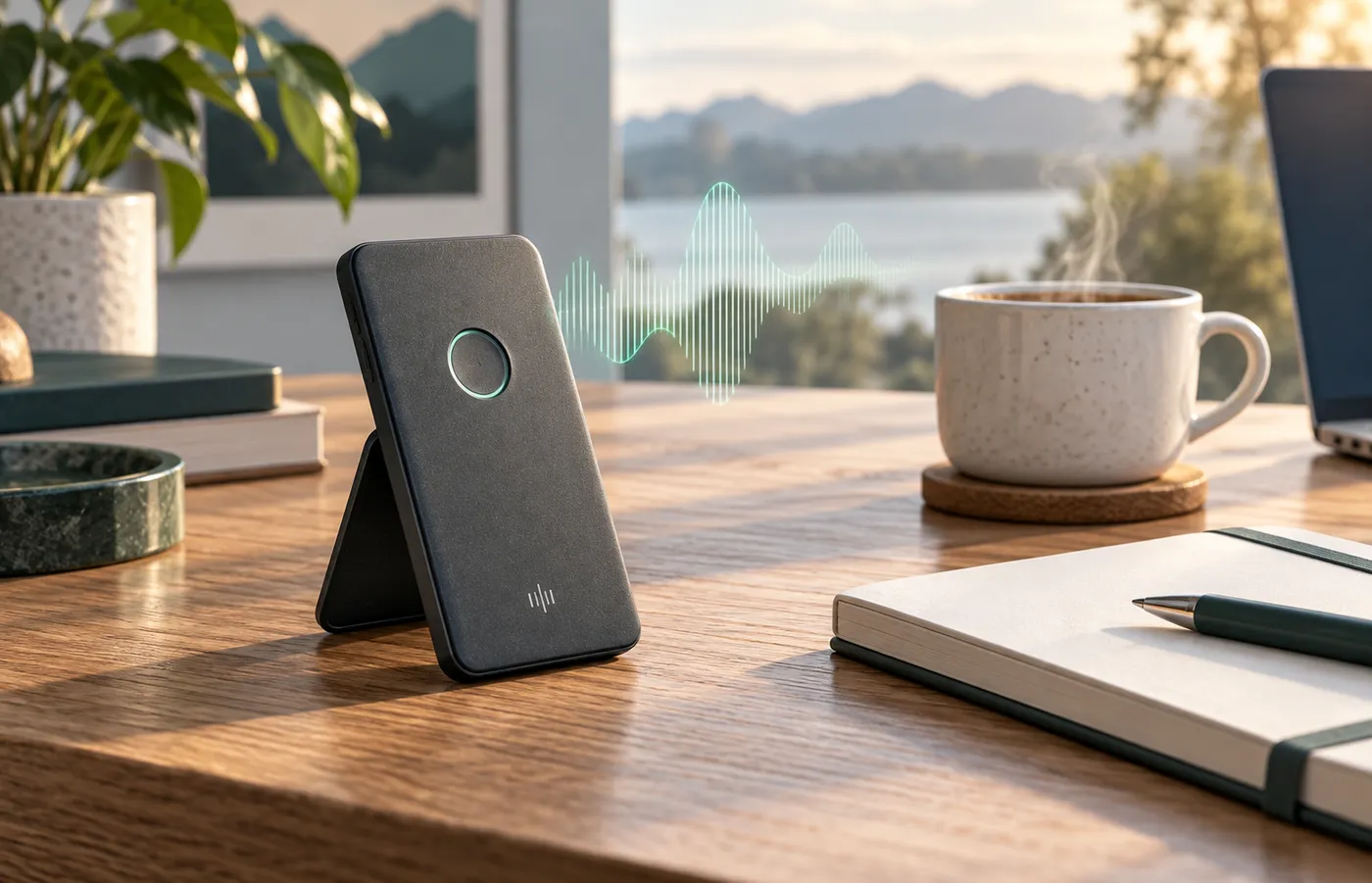
PLAUD also advertises 112-language transcription, which matters if you record in more than one language. And the magnetic case doubles as a stand, so the card props up on a desk or phone for hands-free capture — a small ergonomic detail that owners cite as part of why the Note feels like a finished product rather than a gadget.
What the spec sheet does not capture is the ecosystem. The Note pairs with iOS, Android, and a web app, and integrates with Notion, ChatGPT (via an MCP server), Zapier, and Dropbox. For a professional whose notes feed client work or a content pipeline, that integration layer is often the real reason the Note is worth its price — the transcript does not sit in a silo, it flows into the tools you already use. That is a workflow argument, not a spec argument, and it is the difference between a recorder and a note-taking system.
None of these are independent measurements; they are the maker's published claims, and we have not hands-on-tested the device. We compared published specifications, owner reports, and plan structures. What the claims tell you is what PLAUD is selling: a mature, integrated recorder for professionals who record calls and meetings every week — not a budget experiment.
Practical guidance
Where it disappoints
The honest counterweight is the owner record, and it is genuinely mixed. The most common complaint pattern is standby battery drain: multiple owners report the Note losing most of its charge while idle — "last charged to 100%… only at 2%" is a representative report. The 60-day standby figure is a best case, and the practical fix owners report is charging on a weekly habit rather than trusting the spec. Our battery-drain guide collects the full pattern and the workarounds that actually help.
The second recurring complaint is AI summary template accuracy. Some owners describe template output as "word vomit of odd analysis" — fluent but analytically off-target. PLAUD markets 10,000+ templates, and the tension is structural: a wrong-template match is more likely than a right one. The workarounds owners report working are custom templates, a glossary of your domain's terms, and highlight-and-context input — all documented features. Our template-accuracy guide walks through each.
There is also a physical ceiling worth naming. The longest independent test we found reports that microphone reach degrades in large rooms — consistent with PLAUD's own guidance that pickup stays at 2 to 3 meters in quiet rooms. If you record big lecture halls or large conference rooms, the Note's card form factor is not the strongest choice; our mic-distance guide explains why placement beats hardware in most rooms.
The listing context matters too: the Note's Amazon listing shows 4.5 stars from 5,394 ratings as of September 2026, with PLAUD as the official seller — a large, mature base of buyer feedback. That is a strong signal, but it is a listing fact, not a substitute for reading the complaint patterns. The hardware holds up well over a year of daily use per the longest-running independent diary we found; the software is where the friction lives.
The wrap-up
Who should skip it
The Note is not for everyone, and the honest verdict names who should pass. If you are a light user — a few recordings a month, well under the free tier — the Note's subscription structure is overkill. A cheaper card like the Pocket, which includes unlimited free-tier transcription with no paid plan required, fits a light budget better; our PLAUD vs Pocket comparison lays out the trade. If you are not sure you need dedicated hardware at all, the recorder-vs-phone-app page owns that question.
If privacy is your first concern, the Note's cloud transcription means your audio uploads for processing. For confidential meetings where the audio cannot touch a cloud, an offline device like the iFLYTEK SR302 Pro transcribes entirely on-device with no account and no subscription — the no-subscription guide and the privacy guide cover the offline options. And if you refuse subscriptions on principle, the Note's paid plan is the objection regardless of how good the hardware is.
The through-line is that the Note is worth its price for a specific buyer: someone who records enough that the free tier or the Pro plan is genuinely used, and who values call capture and integrations over raw cost. If that is not you, the honest answer is to spend less or spend differently — not to buy the category default out of habit.
Context
3-year cost reality
The purchase decision is not the hardware price — it is the three-year total. Our 3-year cost study ranks every device by hardware plus the cheapest plan that fits real usage, and the Note lands in the mature-ecosystem band: you pay for app maturity, speaker labels, integrations like Notion and ChatGPT export, and true call capture. Within the PLAUD card family, the Note is the cheapest entry point — the Note Pro adds a display, longer battery, and better mics for a higher hardware price, but the plan is identical on both.
The arithmetic is simple: if the free tier covers you, the three-year cost is just the hardware. If you outgrow it, the Pro plan's annual fee repeats every year, and the three-year total climbs into the same range as the Note Pro's. That is why the volume question comes first — measure your month, then price the plan. The TCO study has the full dataset, and the subscription cost calculator runs the math on any horizon.
The honest framing is that the Note is not the cheapest device in our dataset, and it is not meant to be. It is the cheapest entry into the PLAUD ecosystem, and the value question is whether that ecosystem — call capture, integrations, app maturity — is worth the recurring plan for your specific volume. For a professional who records calls and meetings every week, it often is. For someone who records occasionally, the free tier makes it a one-time purchase and the value is unambiguous.
FAQ