On this page
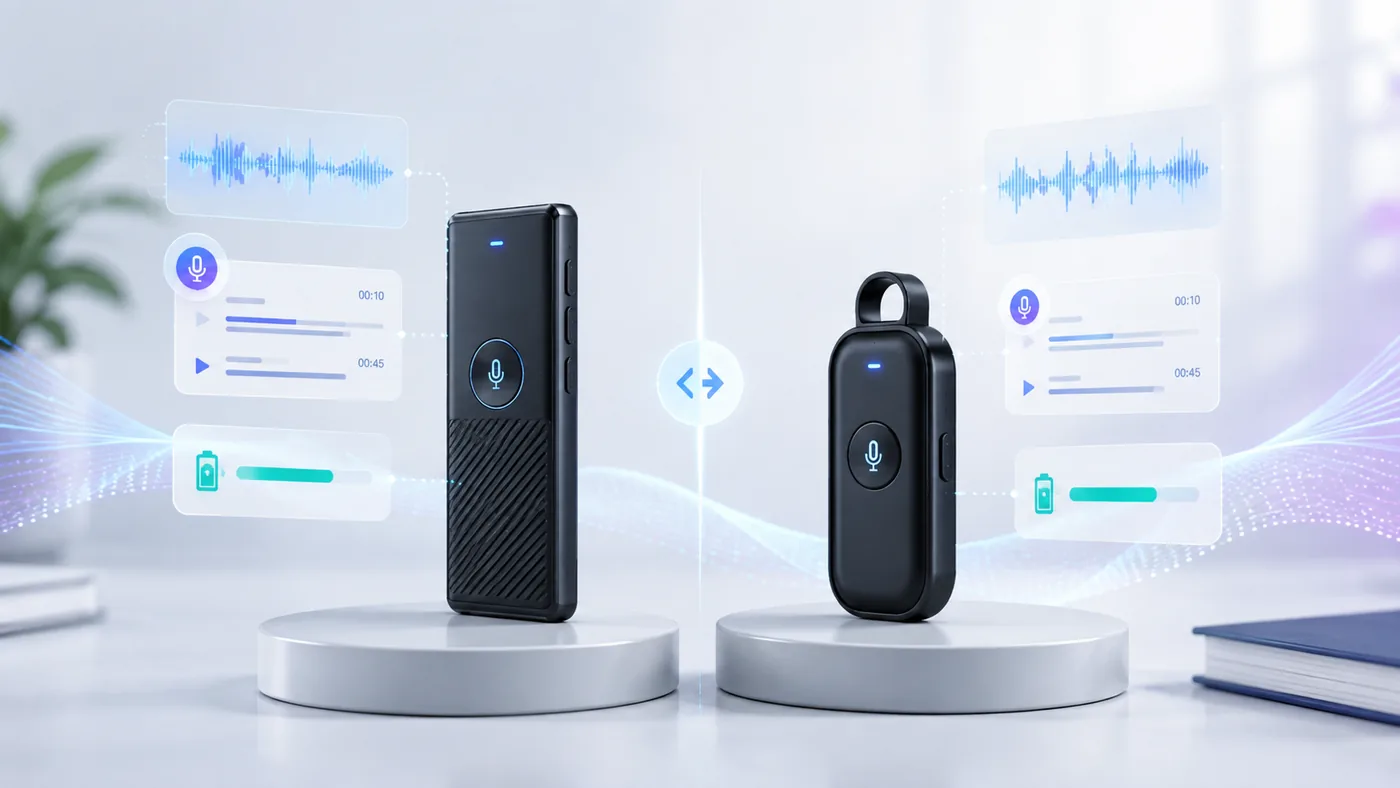
This is a comparison between the category's volume outlier and its most mature ecosystem — and unusually for a head-to-head page, the honest answer is that the spec sheet doesn't settle it. The PLAUD Note is the card recorder that effectively defined this category: 112-language cloud transcription, the vibration-sensor case that makes iPhone call capture possible, and an integration surface (Notion, Zapier, Dropbox, ChatGPT via MCP) that nothing else matches [SPEC]. The Notta Memo is the card recorder built by a transcription-platform company — 4 MEMS microphones plus a bone-conduction call mic, real-time translation in 58 languages, and an InstantView OLED display [SPEC] — sold by the same Notta whose software plans anchor our subscription comparisons.
Most PLAUD comparisons are ladder fights within one brand. This one is genuinely philosophical: PLAUD's paid plans sell you features and workflow depth; Notta's Pro plan sells you minutes — more of them than anyone else in the category. Before the table, three numbers frame everything: 1,800 (Notta Pro's monthly allowance), 300 (PLAUD's free monthly allowance), and $14 (the total three-year price difference between them on Pro, which is almost nothing).
 Comparison illustration
The short answer
Notta Memo wins on transcription volume — the heaviest manufacturer-published allowance we track, 1,800 minutes a month on the $97.99 annual Pro plan — while PLAUD wins on integrations, call-capture maturity, and standby endurance; over three years the total cost is a near-tie, so the choice is minutes versus ecosystem, not price
Lightest free-tier path: PLAUD Note — 300 free min/mo covers most light users [SPEC]
Heaviest published paid allowance: Notta Memo Pro — 1,800 min/mo [SPEC]
Best value elsewhere: TicNote Pro $79/yr — between the two on price and volume
Escape the meter entirely: HiDock P1 or iFLYTEK SR302 Pro — no minutes to track
Specs
Notta Memo vs PLAUD Note: the head-to-head table
| Spec | Notta Memo | PLAUD Note |
|---|---|---|
| Hardware price | $149 [SPEC] | $129–$159 [SPEC] |
| Free transcription | 120 min/mo [SPEC] | 300 min/mo (Starter) [SPEC] |
| Cheapest paid tier | Pro $97.99/yr — 1,800 min/mo [SPEC] | Pro $99.99/yr — 1,200 min/mo [SPEC] |
| 3-year total, Pro plan | $442.97 | $428.97 |
| Cost per 1,000 minutes (Pro) | ≈ $4.54 | ≈ $6.94 |
| Phone-call capture | Yes — bone-conduction mic via magnetic case [SPEC] | Yes — MagSafe case vibration sensor [SPEC] |
| Battery | 30 hrs recording / 28-day standby [SPEC] | 30 hrs continuous / 60-day standby [SPEC] |
| Warranty | Not published as of Sep 2026 [SPEC] — confirm on the listing | 12 months from delivery [SPEC] (plaud.ai, Sep 2026) |
| Storage | 32 GB (≈144 hrs audio) [SPEC] | 64 GB [SPEC] |
| Display | InstantView OLED status display [SPEC] | None on card (Note Pro adds AMOLED) |
| Languages | 58 languages, real-time translation [SPEC] | 112 languages [SPEC] |
| Integrations | Notta platform: Notion, Salesforce (Business tier), calendar sync, Zoom via Notta [SPEC] | Notion, Zapier, Dropbox, ChatGPT (MCP server) [SPEC] |
| Independent coverage | Thinner — fewer long-term reviews to draw on [REVIEW context] | Deep — two years of reviews and owner threads across major outlets [REVIEW context] |
Three rows deserve emphasis. First, the allowance crossover: PLAUD's free tier is 2.5× larger, but Notta's paid tier is 50% larger — which one matters depends entirely on where your monthly volume sits. Second, both devices do true phone-call capture by different hardware tricks (vibration sensing vs bone conduction) — this is not a category where one side fakes it. Third, the storage asymmetry is real: 64 GB versus 32 GB is the one hardware spec where the PLAUD Note plainly wins, and it matters most for people who record offline for days before syncing.
| Cost factor | Notta Memo | PLAUD Note |
|---|---|---|
| Hardware price | $149 | $129–$159 |
| Free monthly minutes | 120 min/mo | 300 min/mo (Starter) |
| Cheapest paid tier | Pro $97.99/yr — 1,800 min/mo | Pro $99.99/yr — 1,200 min/mo |
| 3-year total, Pro plan | $442.97 | $428.97 |
| Cost per 1,000 minutes (paid tier) | ≈ $4.54 | ≈ $6.94 |
Computed from August 2026 editorial research [SPEC]; sale pricing lowers real totals. Per-1,000-minute values are reproduced from our TCO study's per-minute value table.
Where each device actually winsVolume
Where the Notta Memo wins
1. The heaviest manufacturer-published transcription allowance in the category. Notta Memo Pro includes 1,800 minutes per month on a $97.99 annual plan [SPEC] — 600 more monthly minutes than PLAUD Pro and more than any other paid tier we track in our subscription comparison. For buyers whose real usage sits above 1,200 minutes, this is the single decisive spec: it's the difference between rationing transcription and never thinking about the meter.
2. The best cost per 1,000 minutes. Our TCO study's per-minute value table puts Notta Memo Pro at ≈ $4.54 per 1,000 minutes against ≈ $6.94 for PLAUD Pro — roughly 50% more minute value for the dollar [SPEC]. The math is unforgiving arithmetic, not opinion: $97.99 ÷ (1,800 × 12) versus $99.99 ÷ (1,200 × 12). If your cost model is per-minute — sales call logging, interview transcription at volume — Notta wins that framing outright.
3. Translation as a first-class feature. The Memo's platform transcribes 58 languages with real-time translation [SPEC], backed by 4 MEMS microphones plus the bone-conduction call mic. For cross-language meetings and international client calls, that's a workflow PLAUD's 112-language transcription handles well but without the live-translation emphasis.
4. Platform-grade integrations on the software side. Because Notta is a transcription platform first, the Memo inherits platform features: Notion sync, one-click sharing to Slack and Salesforce (Business tier), calendar integration, and Zoom capture through the Notta platform [SPEC]. For Salesforce-centric teams, that's the closest a hardware recorder gets to CRM sync — see our sales guide for that workflow in full.
5. An on-device display. The InstantView OLED shows recording status without opening an app [SPEC] — a small ergonomic edge over the base PLAUD Note's screenless card, and the same design language PLAUD itself only ships on the $189 Note Pro.
Ecosystem
Where the PLAUD Note wins
1. A free tier that's actually livable. PLAUD's Starter plan includes 300 minutes per month [SPEC] — 2.5× the Memo's 120. If your usage is under ~300 minutes, you may never pay either brand a subscription, and the comparison collapses into hardware price plus ecosystem: $129–$159 of proven card recorder with the deepest free experience. For light users, Notta's paid-tier volume advantage is irrelevant.
2. The deepest integration surface in the category. Native Notion export, Zapier automations, Dropbox, and ChatGPT access via the MCP server [SPEC] — PLAUD's export and automation surface is the widest we've cataloged in our exports & integrations guide. Notta's platform covers some of the same ground, but PLAUD's paths into note systems and AI assistants are more numerous and better documented by owners [OWNER].
3. Call-capture maturity. Both devices do true call capture, but they don't arrive with equal receipts. PLAUD's MagSafe-case vibration sensor has been the category's reference method for two years [SPEC], with extensive owner documentation [OWNER]; Notta's bone-conduction approach is newer and thinner on long-term public record [REVIEW context]. Our phone-call capture guide covers both mechanisms.
4. Standby and storage. 60 days of standby versus the Memo's 28 [SPEC], and 64 GB of storage versus 32 [SPEC]. For a recorder that lives in a bag or gets used across long offline stretches — travel, field reporting, back-to-back conference days — that's the difference between charging weekly and charging biweekly, and between syncing daily and hoarding audio offline.
5. Independent coverage you can learn from. PLAUD is the most-reviewed device family in the category [REVIEW context]: its Trustpilot sits around 4.7/5 from 2,000+ reviews as of August 2026, per the brand's own site [SPEC — brand self-report], with years of Reddit owner threads that document real failure modes (speaker-label errors, billing friction) [OWNER]. Notta Memo's public record is thinner. More independent coverage doesn't make a device better — but it makes its weaknesses knowable before you buy, which our review methodology treats as real evidence value.
The verdict
Who each device suits
Choose the Notta Memo if
- You consistently transcribe more than 1,200 minutes a month — Pro's 1,800 min/mo is the heaviest manufacturer-published allowance we track [SPEC], and it's the reason this device exists
- You want the lowest cost per 1,000 minutes in our dataset — ≈ $4.54 versus ≈ $6.94 for PLAUD Pro, per our per-minute table [SPEC]
- Real-time translation is the job — 58 languages with live translation [SPEC], aimed at cross-language meetings and international calls
- Your notes should reach Slack or Salesforce with one click — the Notta platform (Business tier) ships those integrations [SPEC], the closest a hardware recorder gets to CRM sync
Choose the PLAUD Note if
- You'll stay on the free tier — 300 min/mo is 2.5× Notta's 120 [SPEC], and free-tier economics is where PLAUD's cheaper hardware compounds
- Your notes need to flow into a workflow — native Notion export, Zapier automations, Dropbox, and ChatGPT via the MCP server [SPEC]
- Call capture must be boring and proven — the vibration-sensor case is the category's most-tested method [SPEC], with two years of owner experience behind it [OWNER]
- Long unattended stretches matter — 60-day standby versus 28 [SPEC], plus double the storage at 64 GB [SPEC]
If neither fits exactly, the honest outs are these: if you want Notta's per-minute value at a lower hardware price, TicNote's Pro tier ($79/yr, 2,100 min/mo [SPEC]) is the value play — see our PLAUD alternatives guide. If your volume is genuinely heavy but your meetings are online, a recorder may be the wrong tool entirely — bot-free desktop capture is covered in our Zoom & Teams guide. And if you're simply subscription-averse, the devices that refuse the meter altogether are ranked in our no-subscription guide.
One caveat applies to both paths: independent long-term coverage of the Notta Memo is thinner than PLAUD's — fewer in-depth reviews and owner threads exist to learn from [REVIEW context], so some of the PLAUD side's confidence comes from accumulated public experience rather than any single spec. That gap is closing as coverage grows, but as of August–September 2026 it's real, and we weight it accordingly rather than pretending the two brands arrive with equal receipts.
FAQ
Frequently asked questions
Which is cheaper over 3 years?
Can both record phone calls?
Is 1,800 minutes a month actually a lot?
Do either of these work without a subscription?
Research sources
notta.ai Notta Memo product page (specs, 470 mAh battery, 32 GB, 58-language translation) + shop.notta.ai product listing ($149 price, MagSafe case, dual recording modes) — retrieved Sep 2026 · plaud.ai homepage + PLAUD Intelligence plan structure (300 min/mo Starter, Pro 1,200 min/mo, Unlimited) — retrieved Sep 2026 · site datasets: 3-year TCO study (3-year totals, per-1,000-minute value table), subscription comparison (tier ladders, Notta 120 free min/mo), phone-call capture guide (bone-conduction vs vibration-sensor methods), sales guide (Notta Business Salesforce/calendar integrations) — all verified Aug 2026
Prices and subscription terms change often. We verified everything above in August–September 2026; confirm current terms on the manufacturer's page before buying.