On this page
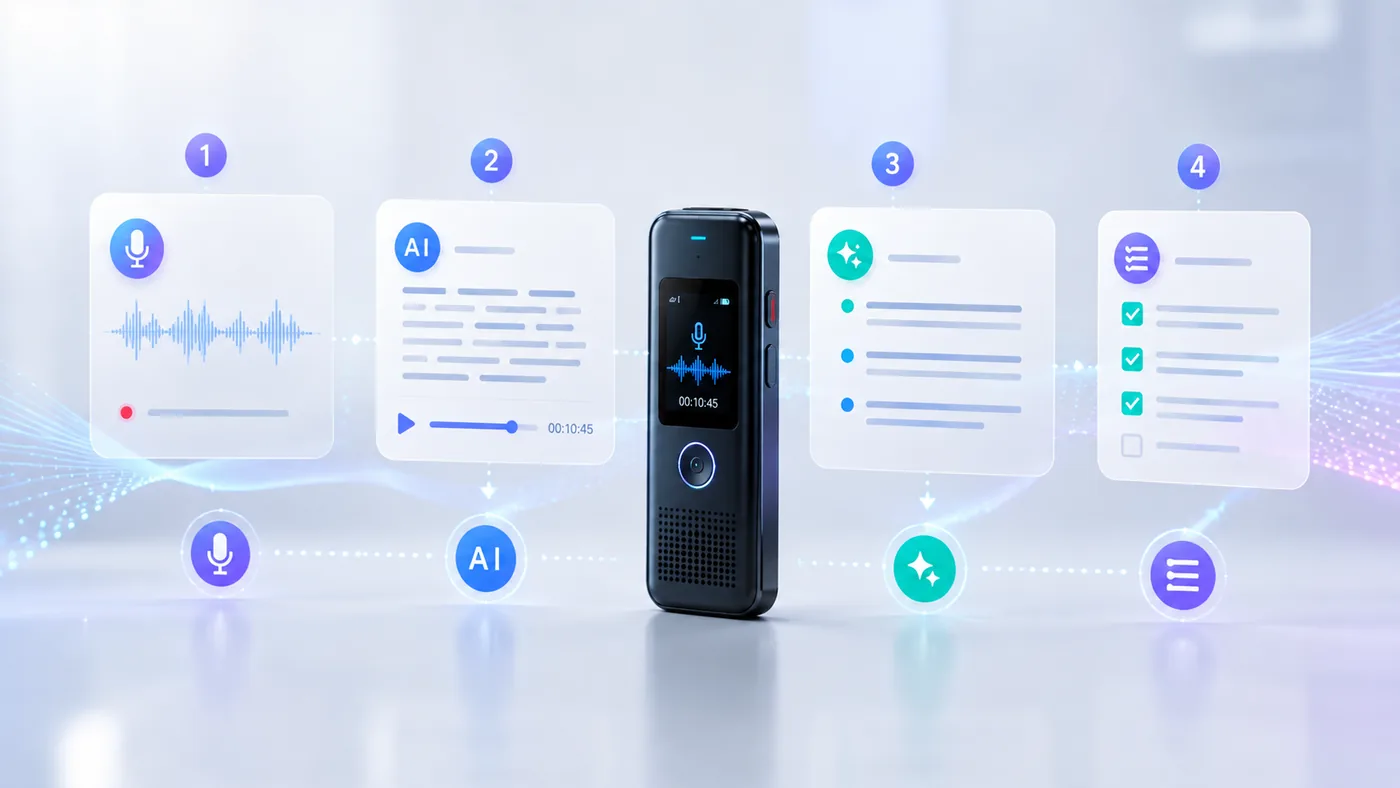
An “AI voice recorder” is not one technology — it's five of them in a row. A microphone array turns sound into a signal, the device stores the audio locally, transcription software turns audio into text, and a large language model (LLM) turns that text into summaries, action items, and answers to your questions. Every device we track — from the wallet-thin PLAUD Note to the offline iFLYTEK handhelds — runs some version of this same pipeline.
Related: device vs phone: the honest breakdown.
Here's what actually matters for buyers: the stages are not equally important. The microphone stage decides whether the recording is worth transcribing at all, and the transcription stage decides where your audio travels. The AI summary stage — the part every advertisement leads with — is the most interchangeable. Miss that ordering and you'll overpay for the wrong thing.
 How it works
The short answer
Microphones capture · devices store · software transcribes · AI summarizes
The pipeline
Five stages, one device
Follow a single conversation from air to summary. This is the honest, jargon-free version of what every manufacturer's marketing slide is showing you:
01Microphone array captures sound
Tiny MEMS microphones (defined in our glossary) convert air pressure into a digital signal. More mics and better placement mean a longer usable pickup range — the single biggest driver of transcription quality.
02The device records locally — always
On every device we track, the raw audio is captured and stored on the recorder itself, with no cloud involvement. Recording is never metered and never needs a subscription. A 64 GB store holds hundreds of hours.
03Storage and sync
Our pick PLAUD Note Check price on Amazon As an Amazon Associate we earn from qualifying purchases. Price & availability shown on Amazon.com.Audio files sit on the device until they sync to your phone over Bluetooth or Wi-Fi. Some devices (PLAUD, Omi) can also keep files moving to the cloud; iFLYTEK keeps everything on the handheld.
04Transcription — cloud or on-device
This is the fork in the road. Cloud devices upload your audio to company servers where a large speech model transcribes it. Local devices run a smaller model right on the hardware. This choice drives cost, privacy, and accuracy — we devote a whole guide to it.
05LLM post-processing
Once text exists, a large language model (the same class of software as ChatGPT) writes the meeting summary, extracts action items, answers questions like 'what did we decide about pricing?', and applies speaker labels.
The transcription fork in stage 04 is where audio either leaves your control or doesn't — the entire subject of our local vs cloud transcription guide and our device-by-device privacy teardown.
Stage 01, the one that matters most
Why the microphones matter more than the AI models
Manufacturers advertise AI features; owners complain about audio quality. That mismatch exists because transcription models are trained on clean speech. When they fail, it's usually not the model's fault — it's that the microphone picked up a distant, reverberant, or noisy version of what was said. No summary model can reconstruct words the microphone never cleanly captured.
Two hardware facts drive most of the practical differences between devices:
- Pickup range beats model quality. A recorder 1–2 meters from the speakers with modest mics will out-transcribe a cutting-edge cloud model fed from across a lecture hall. Placement is free; distance is expensive.
- Mic count and array geometry set the ceiling. The PLAUD Note Pro claims roughly 2× the capture range of the base Note thanks to its upgraded microphone array [SPEC], and the Vibe Dot uses five microphones with a 16-ft listening range [SPEC]. The base Note's single mono mic is why owners report it works best close to the speaker.
The fork in the road
Where transcription happens
Every tracked device records locally — but most transcribe in the cloud. The exceptions matter:
- iFLYTEK SR302 Pro: transcription runs entirely on the handheld, offline, in five languages — English, Chinese, Japanese, Korean, Russian — with no account and $0 in subscription fees, forever [SPEC]. Trade-off: a third-party review found its English output “noticeably less precise” than cloud services [REVIEW — mightygadget].
- Omi: unlimited transcription runs on your phone (locally), with 1,200 cloud minutes/month included if you want them [SPEC].
- soundcore Work: an owner report (an Amazon Vine reviewer) describes a downloadable ~12 GB offline transcription model — promising, but unconfirmed in official specs, so treat it as a bonus rather than a promise [OWNER].
- Everyone else — PLAUD, TicNote, Notta, Pocket, HiDock: audio is uploaded for cloud transcription. PLAUD's support docs say cloud processing happens on servers in the US, Germany, Japan, or Singapore depending on your region [SPEC via support docs].
The full trade-off triangle — privacy, accuracy, and subscription cost — is covered in our dedicated comparison, and the question of who said what is covered in our diarization explainer.
Stage 05
What the AI actually adds
Once a transcript exists, the LLM layer is what turns it into the product you saw in the ad. Across the devices we track, that typically means:
- Summaries
- Structured meeting notes, generated after transcription
- Action items
- Extracted to-dos and decisions, with mixed reliability
- Q&A
- "Ask Plaud"-style chat over your transcripts
- Labels
- Speaker attribution applied to text (diarization)
Two honest caveats from owner reports. First, summaries can invent things: a long-term PLAUD owner documented phantom quotes — lines in the summary no one said — alongside persistent speaker-label errors [OWNER — r/PlaudNoteUsers]. Second, the LLM layer is the most replaceable part of the pipeline: several owners report exporting raw transcripts to ChatGPT for better results than the vendor's own summaries [OWNER]. Our exports and integrations guide covers that workflow, and PLAUD even ships an MCP server so ChatGPT can pull transcripts directly [SPEC].
The obvious question
Why not just record with your phone?
Phones have excellent microphones and can run the same cloud models. Yet owners of dedicated hardware consistently describe four failures of the phone workflow — and these map exactly onto what the hardware fixes:
| Spec | What it fixes | Evidence |
|---|---|---|
| One-button, always-available start | A recorder on your collar or in your wallet starts capturing in one press — the phone is in your pocket, asleep, or distracting you. Owners call unplanned-capture reliability the hardware's core value. | [OWNER] Reddit r/PLAUDAI |
| Battery independence | Recording continuously drains a phone fast. Dedicated devices run 20–50 hours per charge (PLAUD Note Pro: 50 hrs [SPEC]; WaveNote: 42 hrs [SPEC]) without touching your phone's battery. | [SPEC] manufacturer pages |
| Mic placement | A wearable sits ~30 cm from the speaker's mouth; a phone lies flat on a table pointing at the ceiling. Placement beats hardware cost — see the pickup diagram above. | [REVIEW] + physics |
| Phone-call capture | iOS blocks call-recording apps. Hardware like PLAUD's vibration-sensor case and Notta's bone-conduction mic capture both sides of calls through the phone's body — no app can. | [SPEC] plaud.ai, shop.notta.ai |
The counterargument is real, though: if you record rarely, a phone plus a transcription app may genuinely suffice. Our buying guide opens with who should not buy this category at all, and the 3-year cost calculator prices the break-even against your actual recording volume.
FAQ