On this page
A wearable recorder answers the one complaint phones can’t fix: the device has to already be running when the conversation starts. Owners describe the appeal plainly: “The concept is undeniably appealing: a discreet, AI-powered device” — Reddit, r/PlaudNoteUsers. Between CES 2026 and the mid-2026 ring launches, the field went from two credible wearables to more than we can count — Android Police counted ten-plus note-taking wearables at CES alone and called the category “a shameless money grab.”
We haven’t hands-on-tested any of these. What follows synthesizes manufacturer specs [SPEC], third-party reviews [REVIEW], and owner reports [OWNER] — and it favors wearables with published terms over ones whose subscription pricing is still a mystery.
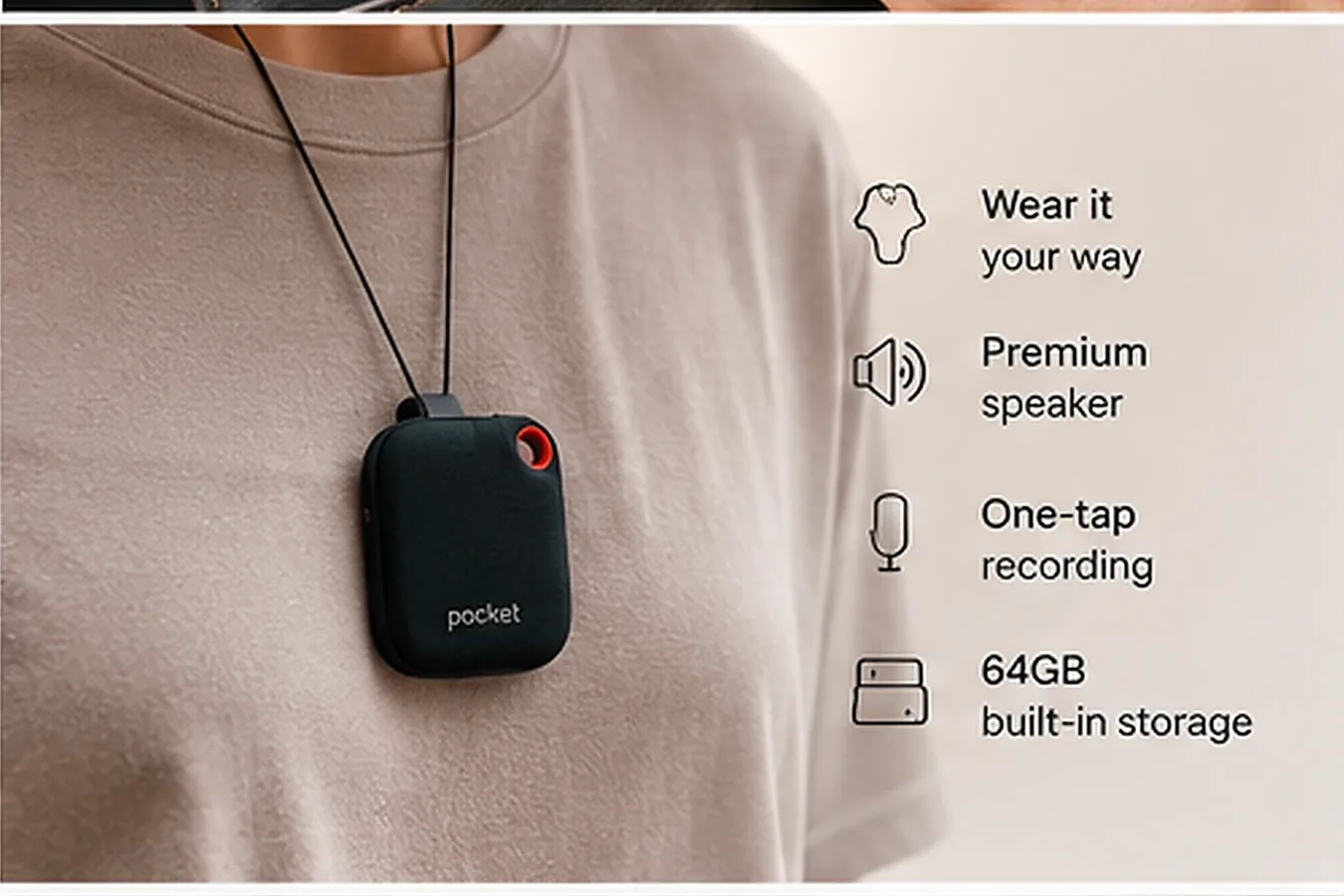 Wearable illustration
The short answer
PLAUD NotePin S for most people · soundcore Work for the budget-conscious · Omi for open-source tinkerers
Max discretion: Vocci Ring — titanium, button-press capture, free 300-min tier (see our Vocci Ring review)
Cheapest hardware: Bee AI Wristband — $49.99, Amazon-owned, subscription structure still settling
Form factor
Why wear it at all
The wearable-vs-card question splits owners into two camps. Card fans prize one-handed start speed and wallet carry: “The Note is much much easier to begin recording” is a recurring verdict on r/PlaudNoteUsers, and one Note owner put it as “I use the note the card sized one and it’s amazing… better form factor than the pin” — Reddit, r/PlaudNoteUsers. Wearable fans prize presence: the recorder is on your collar at 8:59 a.m., not in a bag across the room.
Two physical facts drive most of the trade-offs. First, battery: a 16.6 g puck carries a smaller cell than a wallet card — the NotePin S is rated 20 hours continuous [SPEC] versus 30–50 hours for PLAUD’s cards. Second, capture mode: always-on capture devices (Fieldy, some Omi workflows) record continuously and sort it out later, while button-press devices (Vocci Ring, most others) capture only what you deliberately start — better battery and better optics, at the cost of missing the unplanned moments that justified wearing a recorder. The full decision framework lives in our card vs wearable guide.
Method
How we picked
Wearables are ranked by capture reliability in unplanned moments — the whole point of wearing a recorder — then form-factor honesty (comfort, battery, the nightly charging ritual), then subscription clarity, our honesty metric: wearables with published terms outrank those whose ongoing costs are still a mystery. Optics and consent are part of the evaluation, not a footnote: announce the recorder in meetings, and don't rely on discretion as a feature. All evidence is [SPEC]/[REVIEW]/[OWNER] per the methodology; no hands-on testing.
Not for: buyers who need long battery life without a charging case — every wearable here trades battery for form; the card path avoids that trade.
The picks
Five wearables worth considering
PLAUD
PLAUD NotePin S
CES 2026 refresh with Wi-Fi sync, Press-to-Highlight, and a bigger battery.
Why this pick
The only 2026 wearable with mainstream independent review coverage behind it: Wirecutter (Mar 2026), CNET CES coverage, and krisp.ai's category-best rating [REVIEW]. Press-to-Highlight bookmarks moments live, Wi-Fi + BLE 5.2 sync beats Bluetooth-only rivals, and it ships with clip, lanyard, magnetic pin, and wristband. It's a PLAUD, which means mature software — and the standard 300 free min/mo meter. We flag what PLAUD flags: retailer battery specs conflict (official: 320 mAh / 20 hrs).
- Observed retail*
- $159–$189
- Free minutes
- 300 min/mo
- Transcription
- cloud
- Phone calls
- Placement
- Press-to-Highlight bookmarks key moments during capture
- Wi-Fi + BLE 5.2 — faster syncing than Bluetooth-only wearables
- Ships with clip, lanyard, magnetic pin, and wristband
- Retailer battery specs conflict (PLAUD official: 320 mAh / 20 hrs)
- Only ~$20 cheaper than Note Pro with fewer mics and no screen
- Skip if you need battery confidence without the charging dock — retailer specs conflict with PLAUD's official 320 mAh / 20 hrs
*Observed retail price is editorial research dated August 2026, not a live Amazon price. Verify current price, seller, warranty, and availability before purchase.
The field
Wearable comparison table
| Spec | PLAUD NotePin S | soundcore Work (D3200) | Omi | Vocci Ring | Bee AI Wristband |
|---|---|---|---|---|---|
| Price | $159–$189 | $90–$159 | $179 | $249–$299 | $49.99 |
| Free minutes/mo | 300 min/mo | 300 min/mo | Unlimited | 300 min/mo | Unlimited |
| Form factor | wearable | coin | pendant | ring | wristband |
| Battery | 20 hrs continuous / 40 days standby, 320 mAh [SPEC] | ~8 hrs on-device / up to 32 hrs with charging case [REVIEW] | Multi-day typical use [SPEC] | 8 hrs non-stop + 3 extra charges in case [SPEC] | Unpublished |
| Warranty | 12 months from delivery [SPEC] (plaud.ai, Sep 2026) | No length stated for recorders as of Sep 2026 [SPEC] — confirm on the listing | Not published as of Sep 2026 [SPEC] — confirm before purchase | 1 yr non-EEA / 2 yrs EEA [SPEC] (vocci.ai, Sep 2026) | Not published as of Sep 2026 [SPEC] — confirm before purchase |
| Capture mode | Button-press + Press-to-Highlight | Single-button instant record | Always-listening pendant | Button-press (not always-listening) | Always-on wristband |
| Subscription clarity | Published tiers (300 min free) | Published tiers (300 min free) | Published (unlimited on-phone free) | Unpriced after 3-mo trial | Evolving post-acquisition |
The uncomfortable part
Optics, etiquette, and the law
A recorder on your collar changes the room. Employment lawyers began 2026 by flagging exactly this: “Is Someone Recording? Managing the Workplace Risks of Portable AI Notetakers” (Workplace Privacy Report, Aug 2026) and JD Supra’s warning that discreet recorders “reduce visibility” both treat always-worn recorders as a growing risk area. Meanwhile r/privacy carries threads from people trying to opt out of colleagues’ AI note-takers.
Our position, grounded in the legal sources in our consent guide: one-party vs all-party consent varies by state, but disclosure norms are stricter than the law in most professional settings. Practical rules that hold up everywhere: announce the recorder in meetings, don’t rely on discretion as a feature, and prefer button-press capture over always-listening in any room you don’t control. For what each device does with the audio afterward, see where your recordings actually go.
Voice journaling: the wearable’s quiet second job
A pin or wristband that is already on your body captures the thought you would never type — several wearable makers lean into it (Bee markets “daily memories” [SPEC, bee.computer Sep 2026]). For private journaling, the honest notes are privacy (where audio is processed — our privacy guide covers each ecosystem) and the export path (your reflections should outlive any subscription — the data-export guide). No wearable on this page is marketed as a diary; the capture is simply always with you.
FAQ