On this page
Recording a phone call should be trivial. It isn’t, because Apple made it hard: iOS restricts apps from accessing the call audio stream, so the App Store has no reliable call recorders — and Android restricts it too in recent versions. Hardware recorders sidestep the platform entirely by capturing sound outside the software: through the phone’s body, through your earphones, or through a mic pressed to the glass.
Related: call capture compared: TicNote vs PLAUD Note.
The urgency is real and current — on r/PLAUDAI, an on-the-fence buyer names “recording unplanned phone calls” as “still a major pain point” on phones [OWNER], and PLAUD markets itself as “the only AI note-taking platform that bridges in-person, phone calls, and online meetings.” No hands-on testing claims here; evidence is [SPEC]/[REVIEW]/[OWNER] throughout. One thing before any hardware discussion: consent law applies to every method below.
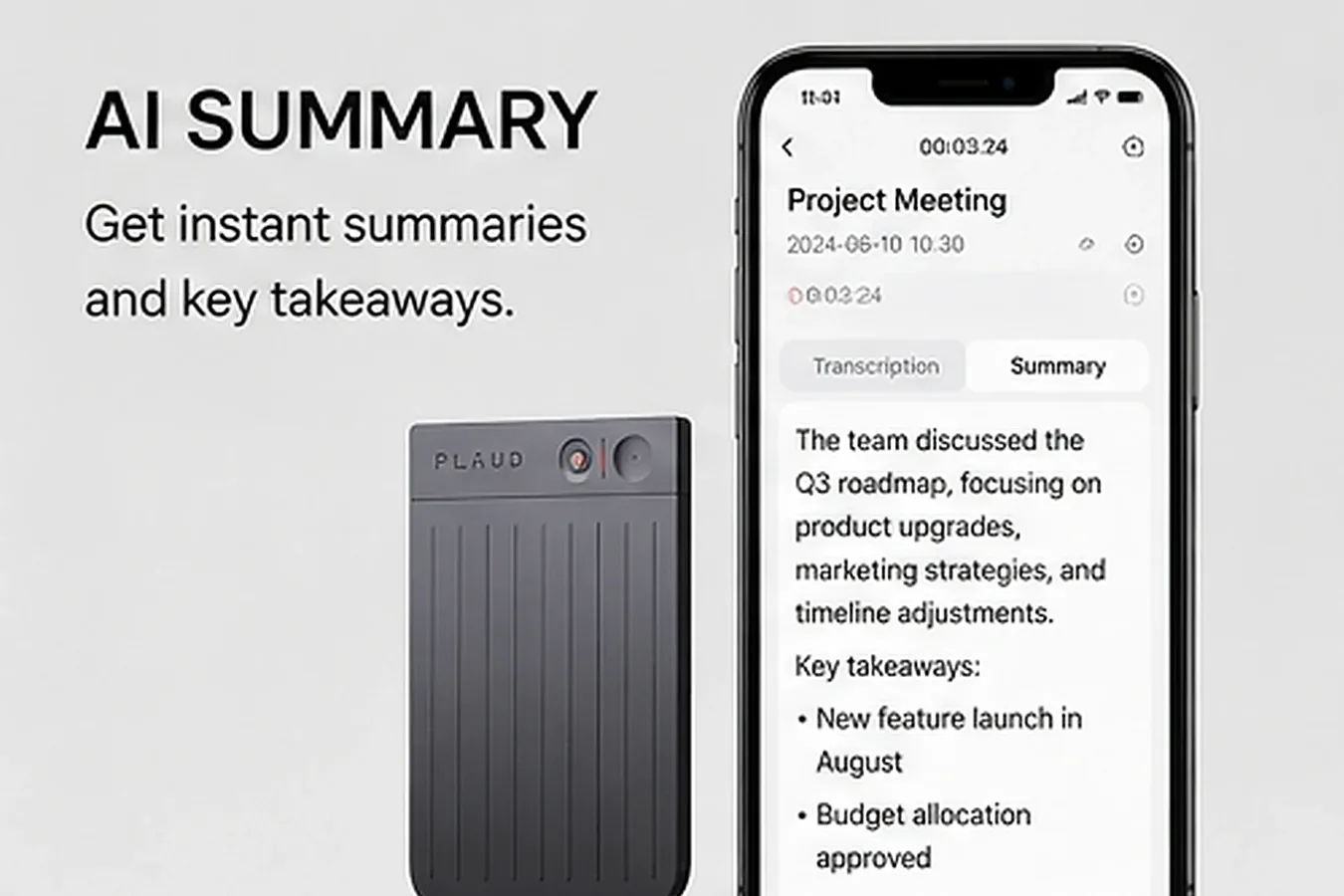 Call-to-summary workflow
The short answer
PLAUD Note Pro for built-in call capture · PLAUD Note for the classic case method · HiDock P1 for calls without a subscription
Multilingual calls: Notta Memo — bone-conduction mic, 58 languages [SPEC]
Watch the meter: All PLAUD devices share the 300 free min/mo Starter tier
The platform problem
Why apps can't record iPhone calls
iOS doesn’t expose call audio to third-party apps — there’s no supported API for the voice stream, so App Store call recorders are workarounds (conference-call bridges, speakerphone re-recording) rather than recorders. That’s why the workarounds people ask about — “how does Plaud record phone calls?” is a recurring community question — are all physical, not software.
The hardware answer reframes the problem: instead of getting inside the call, capture the audio where it physically exists — vibrating through the phone’s chassis, passing through your earphones, or leaving the speaker. Three companies built products around three of those surfaces. Android offers more built-in and app routes — PLAUD’s own guides catalog them — so the hardware workaround matters most on iPhone; pairing quirks for both platforms are covered in our iPhone & Android guide.
The physics
The three hardware methods
| Spec | Vibration-sensor case | Bone-conduction mic | Bluetooth-earphone capture |
|---|---|---|---|
| How it works | Sensor in the MagSafe case pressed to the phone picks up call audio from the body of the device [SPEC] | A mic reads sound conducted through the phone's physical structure when attached [SPEC] | Recorder pairs with your BT earphones and captures the call audio you hear [SPEC] |
| Devices | PLAUD Note (case included) | Notta Memo | HiDock P1 |
| Both sides captured | Yes [SPEC] | Yes [SPEC] | Yes — what you hear in the earphones [SPEC] |
| Setup ritual | Card magnetically mounted on the back; case mode | Magnetic attachment during calls | Call routed through paired earphones |
| Without any hardware | Built-in on Note Pro — no case needed [SPEC] | — | — |
A note on expectations, from the community: the Facebook Plaud group’s recurring question is whether the vibration sensor really captures both sides — owners in the handset-mode thread report it does, when the case is properly seated [OWNER]. Like every acoustic method, seat it well and expect to verify on your first calls.
Method
How we picked
Call capture is where marketing copy diverges most from physics, so we rank by capture-method truthfulness first: true call capture (magnetic-case vibration sensor or bone-conduction mic) beats placement-only acoustic capture, which beats nothing. Then platform fit — iOS has no native call-recording API, which is precisely why this hardware category exists — then 3-year cost, then consent exposure, because the same device that makes capture effortless makes evidence of non-consent equally effortless. Every claim is [SPEC]/[REVIEW]/[OWNER]; no hands-on testing.
Not for: one-off call recording — a carrier service or placement trick may cover a single need; this page is for people who record calls weekly.
The picks
Four recorders that capture calls
PLAUD
PLAUD Note Pro
Flagship card with an AMOLED screen, bigger battery, and built-in call capture.
Why this pick
The Note Pro's automatic dual-mode detection removes the manual-switching ritual — it senses phone calls on its own when phone-attached [SPEC] (plaud.ai, Sep 2026) — which is precisely the 'unplanned calls' pain point owners cite. Add the 2× mic range for in-person follow-ups and a 50-hour battery, and it's the complete communications recorder. Standard PLAUD metering applies: 300 free min/mo before Pro ($99.99/yr).
- Observed retail*
- $189
- Free minutes
- 300 min/mo
- Transcription
- cloud
- Phone calls
- Yes
- 2× microphone capture range vs the base Note — better in larger rooms
- AMOLED display for on-device status without opening the app
- Records phone calls without needing the magnetic case
- $30–60 premium over the base Note
- Same subscription metering as the cheaper Note
- Skip if calls are occasional — the base Note carries the same capture method and the same meter at a lower price
*Observed retail price is editorial research dated August 2026, not a live Amazon price. Verify current price, seller, warranty, and availability before purchase.
PLAUD
PLAUD Note
The category-defining card recorder that rides on the back of your phone.
Why this pick
The original and best-known iPhone call workaround: the magnetic case's vibration sensor captures both sides of calls from the phone's body [SPEC], and owners using the Note 'solely for phone call recording' report it works well in handset mode [OWNER]. At $129–159 it's the cheapest proven PLAUD path to call capture. Requires the card-on-case ritual, and speakerphone mode is the place to verify your first recordings.
- Observed retail*
- $129–$159
- Free minutes
- 300 min/mo
- Transcription
- cloud
- Phone calls
- Yes
- Thinnest card format in the category — genuinely wallet-able
- Best-known call-recording workaround for iPhone via the magnetic case
- Mature app: speaker labels, summaries, Notion + ChatGPT export
- Only 300 free transcription minutes/month; Unlimited costs $239.99/yr
- Cloud-only transcription — no offline option
- Skip if you record all day — 300 free min/mo meters fast at call volumes
⚠ Trustpilot shows 4.6/5 (~899 reviews), but Reddit contains recurring complaints about subscription value, speaker labels, and support. Weigh both.
*Observed retail price is editorial research dated August 2026, not a live Amazon price. Verify current price, seller, warranty, and availability before purchase.
HiDock
HiDock P1
Card recorder + Bluetooth-earphone call capture with lifetime free transcription.
Why this pick
HiDock's method is the most natural if you already take calls through Bluetooth earphones: the P1 pairs with them and captures the call as you hear it, both sides included [SPEC]. Pair that with lifetime unlimited transcription — no meter to watch across a call-heavy month — and it's the volume user's call recorder. Trade-offs: desk-leaning hardware design and unpublished battery specs.
- Observed retail*
- $169
- Free minutes
- Unlimited
- Transcription
- cloud
- Phone calls
- Yes
- Strongest no-subscription value: unlimited transcription for life of device
- Unique Bluetooth-earphone method captures both call sides
- $169 total 3-year cost — cheapest credible card path
- Specs now published (64 GB / 600 mAh, hidock.com Sep 2026) — recheck before buying
- Smaller brand than PLAUD/Anker
- Skip if you're on iPhone — manufacturer compatibility is listed at iPhone 15 and later [SPEC]
*Observed retail price is editorial research dated August 2026, not a live Amazon price. Verify current price, seller, warranty, and availability before purchase.
Notta
Notta Memo
Card recorder from the Notta transcription platform, with a bone-conduction call mic.
Why this pick
The Memo's bone-conduction mic reads call audio through the phone's body during magnetic attachment [SPEC], and Notta's platform transcribes 58 languages with real-time translation [SPEC] — the strongest option when your calls cross languages. Business-plan buyers get Salesforce and calendar integrations alongside [SPEC]. The 120 min/mo free tier is the stingiest in the category, so budget for a plan.
- Observed retail*
- $149
- Free minutes
- 120 min/mo
- Transcription
- cloud
- Phone calls
- Yes
- Widest language set with real-time translation
- Bone-conduction mic gives a hardware call-capture path
- Business plan adds CRM + calendar integrations
- Free tier is only 120 min/mo
- 32 GB storage is half the category norm
- Skip if calls are the whole job — the 120 min/mo free tier is the thinnest meter in this guide
*Observed retail price is editorial research dated August 2026, not a live Amazon price. Verify current price, seller, warranty, and availability before purchase.
Every method, same rule
Consent before any call
Hardware solves the capture problem; it does nothing about the legal one. Recording a phone call without required consent can expose you to civil liability and, in some states, criminal penalties — and the same device that makes capture effortless makes evidence of non-consent equally effortless.
Two practical disciplines: use a recorded-line disclosure (“This call is being recorded for notes — okay to continue?”), and know the rule for every state you call into. The full map — one-party vs all-party, phone-specific rules, workplace variants — lives in recording consent laws. If your calls are sales calls, the team-policy layer matters too: the sales guide covers it.
Warranty at a glance
Warranty at a glance: PLAUD Note and Note Pro — 12 months from delivery [SPEC] (plaud.ai, Sep 2026); HiDock P1 — 18 months for hidock.com purchases [SPEC] (hidock.com, Sep 2026); Notta Memo — not published as of Sep 2026 [SPEC], so confirm terms on the listing before purchase.
FAQ