On this page
A lecture hall is the hardest room in this guide. The speaker is meters away, HVAC hums underneath, reverb blurs word boundaries, and student questions arrive from nowhere at random angles. Most “best recorder for lectures” lists are written by the manufacturers themselves — PLAUD’s and soundcore’s blogs currently rank for the query — and none of them lead with the two specs that actually matter here: microphone range and battery endurance.
- Distance: the speaker is meters away — check microphone range, not marketing claims.
- Angle: placement relative to the speaker changes clarity more than hardware class does.
- HVAC hum: building noise sits under every lecture — mics and software must filter it.
- Reverb: halls blur word boundaries; ask how each device handles echo.
- Question capture: student questions arrive from nowhere at random angles — range and room coverage decide whether they survive.
Related: recording lectures legally.
This page is the capture-quality companion to our students guide (which handles the budget and free-tier math). No hands-on testing claims here — everything is [SPEC], [REVIEW], or [OWNER] evidence, consistent with our methodology.
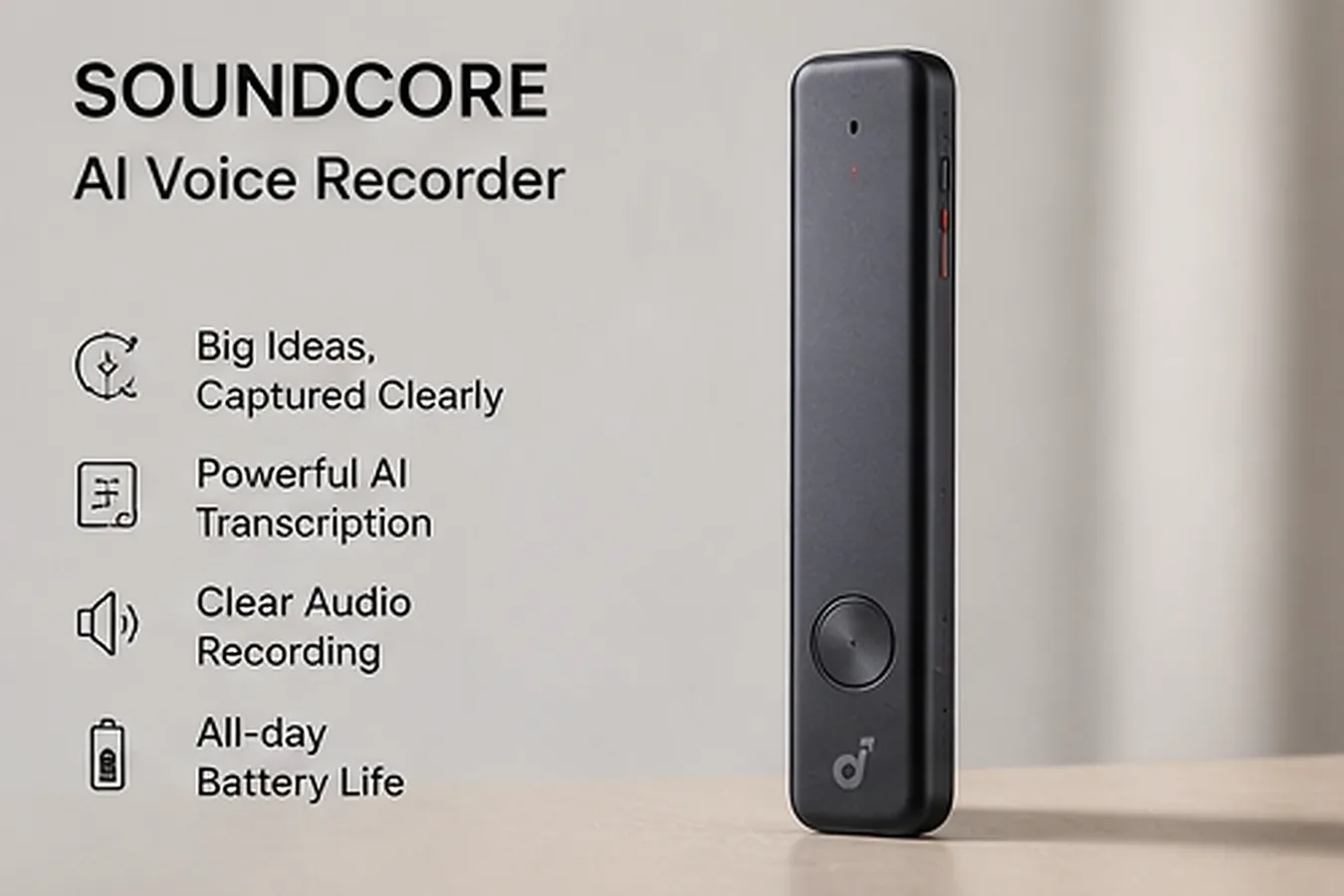 Product illustration
The short answer
PLAUD Note Pro for big halls · WaveNote for marathon days on a budget · TicNote for the free-tier math
Offline option: iFLYTEK SR302 Pro — no cloud, no meter, front-row accuracy
Owner's verdict on Pro vs Note: 'The mic is smugly better on the Pro, but for classroom lecture… you'll be fine' — Reddit, r/PLAUDAI
The physics
What big halls do to audio
Beyond roughly five meters, a standard recorder’s usable signal collapses into room noise — and the transcript degrades with it. Distance, crosstalk, and reverberation cause most accuracy failures, not the AI model. Two device-side answers exist: a stronger mic array (the Note Pro’s approach) or getting the recorder physically closer to the speaker (see placement below).
One owner data point worth internalizing, from the Note-vs-Pro decision thread: “The mic is smugly better on the Pro, but for classroom lecture… you’ll be fine” — Reddit, r/PLAUDAI. Translation: if you sit near the front, the base Note’s mic is adequate and the Pro’s premium buys you seating freedom, not a different product.
Method
How we picked
Lecture-hall physics set the order: capture range first (beyond roughly five meters, a standard recorder's usable signal collapses into room noise), battery endurance second, 3-year cost on a student budget third. No hands-on testing claims — everything is [SPEC], [REVIEW], or [OWNER] evidence per our methodology. Placement beats hardware, so we favor picks that reward good placement instead of punishing bad seats — and we say so when seating freedom is what a premium actually buys.
Not for: fully online courses — a meeting-bot path fits better; the Zoom/Teams guide covers it.
The picks
Four recorders that survive a lecture hall
PLAUD
PLAUD Note Pro
Flagship card with an AMOLED screen, bigger battery, and built-in call capture.
Why this pick
The only card in the category that advertises a mic story for distance: 2× microphones with roughly 2× capture range versus the base Note [SPEC]. If you can't always sit front-row — or the course assigns seating — that range is what keeps the professor's words out of the noise floor. 50-hour battery means the Monday charge lasts the week [SPEC]. Same 300 free min/mo meter as every PLAUD device.
- Observed retail*
- $189
- Free minutes
- 300 min/mo
- Transcription
- cloud
- Phone calls
- Yes
- 2× microphone capture range vs the base Note — better in larger rooms
- AMOLED display for on-device status without opening the app
- Records phone calls without needing the magnetic case
- $30–60 premium over the base Note
- Same subscription metering as the cheaper Note
- Skip if you sit near the front — the base Note's mic is adequate, and the premium buys seating freedom
*Observed retail price is editorial research dated August 2026, not a live Amazon price. Verify current price, seller, warranty, and availability before purchase.
Keep reading
Mobvoi
TicNote
Card recorder with live transcription and the category's most generous free tier.
Why this pick
600 free transcription minutes/month [SPEC] covers roughly six 90-minute lectures (or a dozen 50-minute ones) before you pay anyone anything — and Pro at $79/yr for 2,100 min/mo is the cheapest escape hatch in the category. Live on-screen transcription lets you verify capture mid-lecture, and ~25 hours of battery handles a normal class day [SPEC].
- Observed retail*
- $99–$160
- Free minutes
- 600 min/mo
- Transcription
- cloud
- Phone calls
- Placement
- 600 free minutes/month covers many students and light users entirely
- Live on-screen transcription while recording (PLAUD processes after)
- Pro at $79/yr for 2,100 min/mo is the cheapest paid tier in our dataset
- Brand presence and US retail availability trail PLAUD
- BGR questions subscription value for light users
- Skip if you transcribe everything you record — 600 free min/mo still needs selective transcription
*Observed retail price is editorial research dated August 2026, not a live Amazon price. Verify current price, seller, warranty, and availability before purchase.
iFLYTEK
Smart Recorder SR302 Pro
Handheld recorder that transcribes on-device — no cloud, no account, no subscription.
Why this pick
Transcription runs on the device itself — no cloud, no account, no meter, ever [SPEC] — which makes semester-long cost exactly zero. The strategy: sit near the speaker (its handheld form and 2.0″ screen suit deliberate placement), and let the offline engine handle the rest. English accuracy trails cloud leaders [REVIEW], so it trades polish for permanence.
- Observed retail*
- $128–$249
- Free minutes
- Unlimited
- Transcription
- local
- Phone calls
- No
- The only mainstream recorder that transcribes entirely on-device
- $0 subscription, ever — lowest total cost in the category
- Traditional handheld form factor with a screen and physical controls
- English accuracy trails cloud leaders per third-party reviews — struggles with accents
- Bulkiest form factor here — not pocket-invisible
- Skip if verbatim English accuracy is required — it trails cloud leaders [REVIEW], though no meter ever runs
*Observed retail price is editorial research dated August 2026, not a live Amazon price. Verify current price, seller, warranty, and availability before purchase.
Free upgrade
Placement beats hardware
The cheapest transcription upgrade in this category is distance. Options, in order of effectiveness:
- Sit closer. Halving the distance to the speaker does more for accuracy than doubling the microphone array — the physics of the pickup diagram above.
- Ask to place the recorder up front. Instructors who permit recording usually permit placement near the lectern; it’s also the moment to get consent on the record (see consent laws).
- Point the mics. Card recorders have a front; aim it at the speaker rather than the ceiling.
- Watch crosstalk. Student questions from the back are the hardest thing any recorder captures. If Q&A matters, a wearable on the asker’s side of the room beats a better card — the wearables guide covers those.
Endurance math
File caps and all-day battery
| Spec | PLAUD Note Pro | WaveNote | TicNote | Smart Recorder SR302 Pro |
|---|---|---|---|---|
| Price | $189 | $119–$129 | $99–$160 | $128–$249 |
| Free minutes/mo | 300 min/mo | 0 min/mo | 600 min/mo | Unlimited |
| Battery | 50 hrs continuous (500 mAh) [SPEC] | 42 hrs continuous [SPEC] | ~25 hrs continuous, 470 mAh [SPEC] | Up to 7 hrs continuous recording [SPEC] |
| Warranty | 12 months from delivery [SPEC] (plaud.ai, Sep 2026) | 1 year per product page [SPEC] (wavenote.ai, Sep 2026) | 1 year from receipt [SPEC] (ticnote.ai, Sep 2026) | 1 year [SPEC] (store.iflytek.com, Sep 2026) |
| Mic story for halls | 2× mics, ~2× range [SPEC] | Standard card mics | Standard card mics + live transcription | Long-distance audio; place up front |
| A 12-lecture week (50 min each) | 600 min/wk → Unlimited tier or selective transcription | 600 min/wk → subscription terms unverified | 600 min/mo free covers ~1 week; Pro ($79/yr, 2,100 min/mo) still needs selective transcription | No meter — transcribe everything [SPEC] |
A full lecture load is the most expensive transcription profile we analyze — a professor on r/Professors sized it as “50 minutes, four times a day, three days a week, for 16 weeks” [OWNER]. Run your actual schedule through the minutes calculator, and compare the subscription answer against the no-meter devices in our no-subscription guide before committing to an Unlimited tier.
FAQ