On this page
Best AI Recorders for Lawyers in 2026 (Privilege and Consent First)
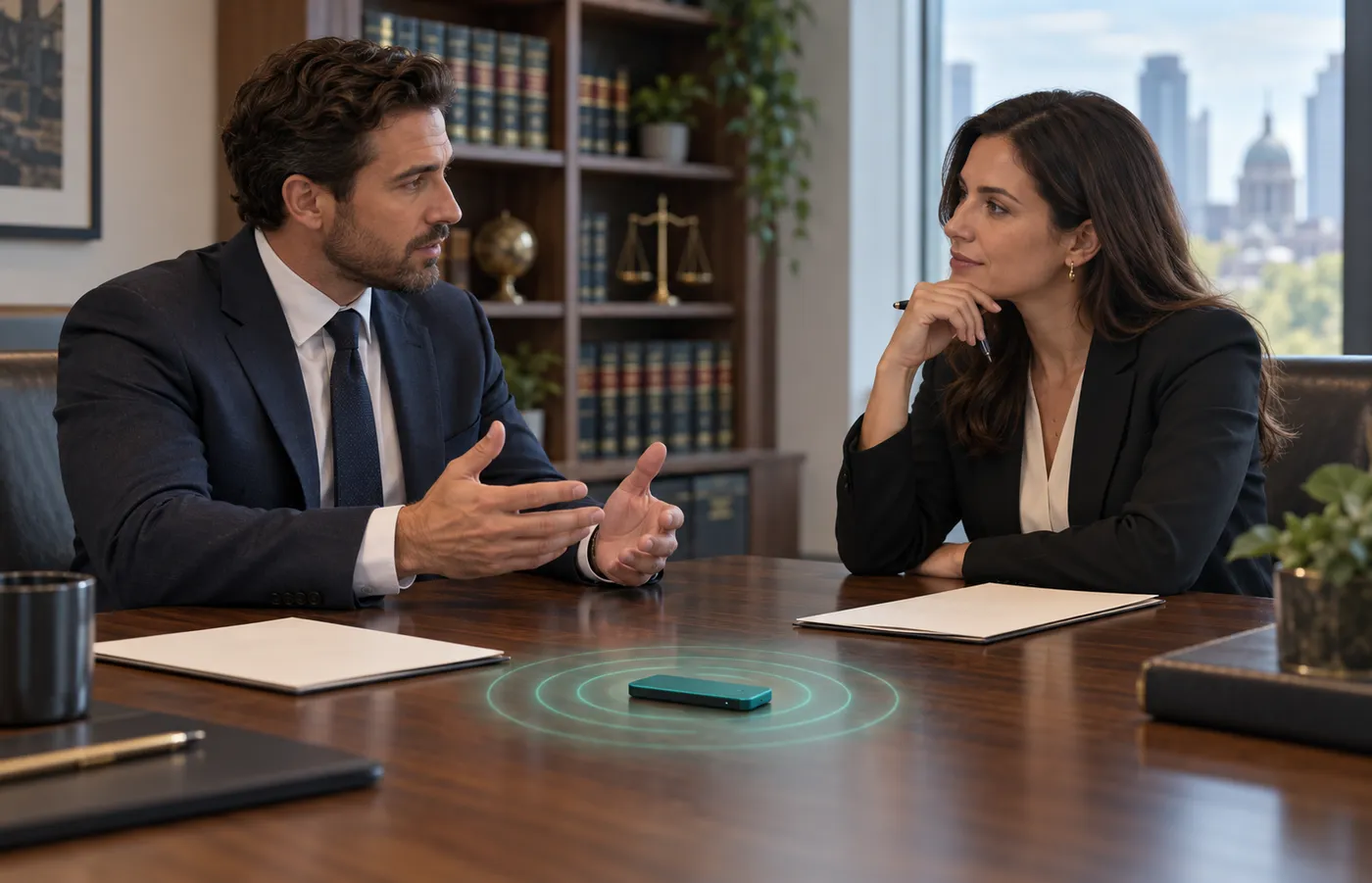
Lawyers arrive at this decision with a constraint most buyers never consider: much of what a practice records is privileged, and privilege is easier to protect before capture than to repair afterward. The question that should lead your shortlist is not which device writes the flashiest summary — it is where the audio goes when transcription happens, whether your state's consent rules are satisfied, and whether the hardware fits the two conversations that fill a legal calendar: the client interview across the desk and the phone call.
Search results for a voice recorder for lawyers still surface dictation-era hardware and generic roundups. The 2026 market is different: card recorders that capture calls, a handheld that transcribes entirely offline, and free tiers that change the math for deposition-volume transcription. This guide ranks four devices the way a practice would: privilege posture first, consent exposure second, capture fit third, 3-year cost last. We compared published specs, owner reports, and plan structures — no hands-on testing, every figure attributed.
The short version
How we matched
We matched devices to legal work using the same evidence rules as our journalists' guide and meetings' guide: no hands-on testing — every claim is labeled for manufacturer documentation, for independent coverage, or for owner reports, per our review methodology. The ranking weighs privilege posture first — whether transcription can happen without any upload — then consent exposure: what each device makes easy to disclose and hard to do covertly. Capture fit comes third: the desk-side client interview and the phone call. Volume economics come last, though for deposition-heavy practices they may deserve to come first, because free tiers break at exactly the wrong moment.
Maker figures stay maker-claimed throughout: PLAUD's 16.4-foot pickup range and 50-hour battery are published figures, and our mic-distance guide explains the smaller honest working range we plan around.
Not for: litigation teams whose firms already run court-reporter workflows — a certified deposition record is a different product category than an AI note-taker, and no device here replaces one.
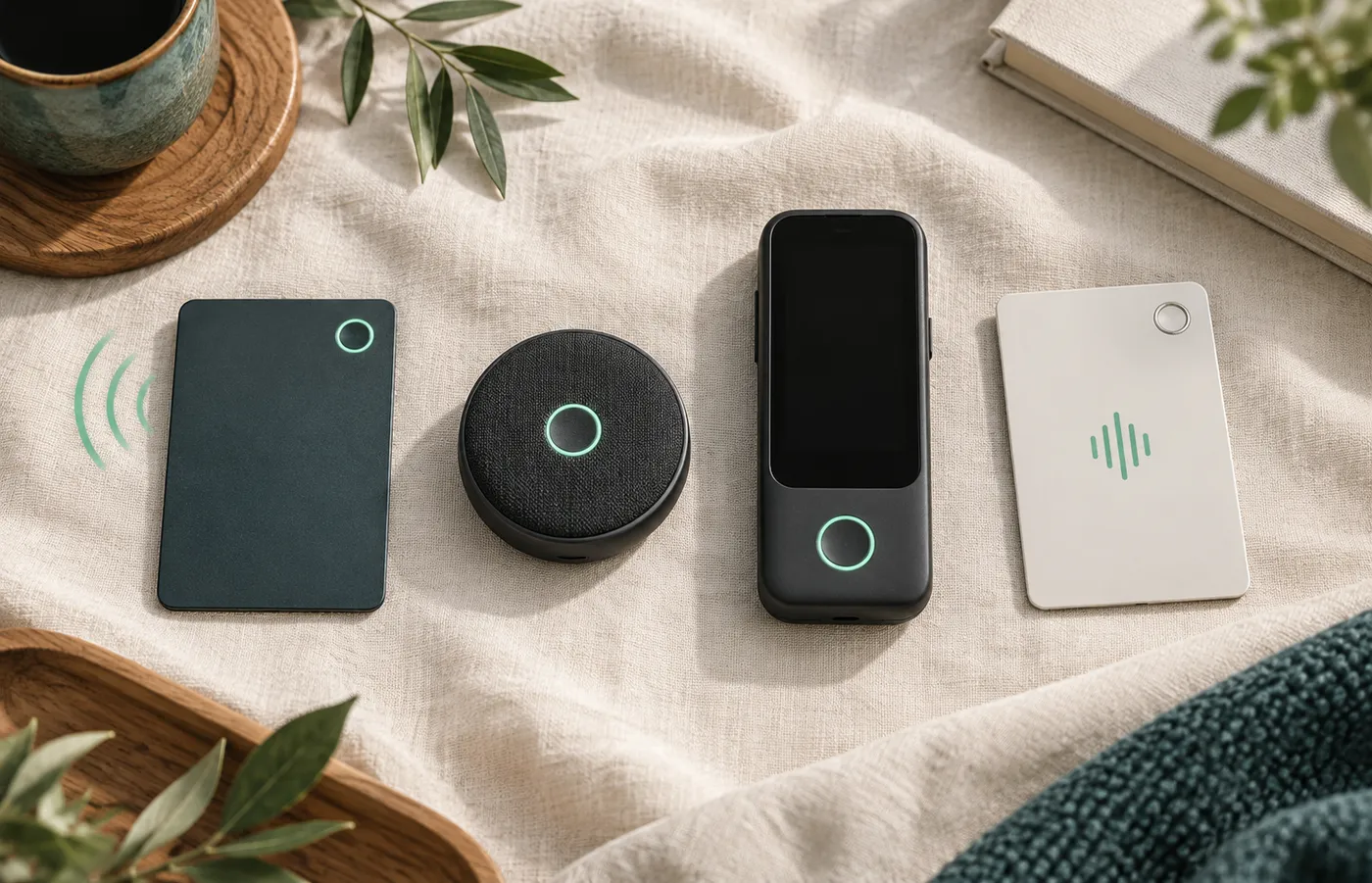
The details
The picks: four devices, four practice profiles
1. PLAUD Note Pro — the all-day pick for client interviews and court days
The pick. For a practice that records all day in real rooms — client conferences, witness prep, multi-party negotiations — the Note Pro is the strongest hardware card in our dataset. PLAUD advertises a four-MEMS-plus-VPU microphone array with voice capture up to 16.4 feet, the longest quoted range on any card recorder we track, plus a maker-claimed 50-hour continuous battery that outlasts a court day without a charger.
Why it fits. A two-person consultation across a desk is easy duty for any recorder; the Pro's array earns its keep in conference rooms and deposition-style setups where the far chair sits meters away — though range claims are ceilings, and halving the distance to the quietest speaker beats any microphone array. The Pro also detects phone-attached versus in-person mode automatically, which matters when the conversation moves to a call. The posture caveat is structural: transcription processes on PLAUD servers in the US, Germany, Japan, or Singapore by region [SPEC via support docs] — fine for routine matters, a decision point for privileged ones (below). The free tier is 300 minutes a month, and the device carries the heaviest 3-year total in our dataset once a paid plan enters. The Amazon listing holds a 4.5-star average across more than 2,800 ratings with the official seller and Prime shipping (September 2026). Owner reports commonly flag speaker-label errors in crosstalk — verify attribution before anything enters a file memo. Full details in our PLAUD Note Pro review.
Skip if. Privilege posture forbids any upload — the SR302 Pro below is the clean answer — or your rooms stay small and calls matter more than range; the base Note covers both for less hardware.
2. PLAUD Note — the call-capture pick
The pick. If your recording life happens on the phone — client check-ins, co-counsel strategy calls, adjuster conversations — the base Note is the best-documented call-capture card in the category: its magnetic case reads call audio through a vibration sensor, a hardware workaround that matters on iPhone, where call-recording apps are restricted.
Why it fits. The maker-claimed battery runs 30 hours continuous with up to 60 days standby, the wallet-thin card disappears into a jacket on court days, and the app is the category's most mature: speaker labels, summaries, exports into Notion or ChatGPT. Same 300 free minutes monthly, same cloud posture, same PLAUD server regions [SPEC via support docs]. The listing carries a 4.5-star average from more than 5,300 ratings as of September 2026 — the largest owner base we track, and the most owner-reported quirks to read before buying. Full details in our PLAUD Note review.
Skip if. Your rooms run larger than a huddle table — the Pro's array is the range upgrade — or privilege requires staying offline entirely.
3. iFLYTEK Smart Recorder SR302 Pro — the privilege play
The pick. Where the conversation itself is the risk — privileged strategy sessions, sensitive client matters, anything a subpoena could reach — the SR302 Pro is the only mainstream recorder we track that transcribes entirely on-device: no account, no cloud upload, no subscription, in five languages. The audio physically cannot reach a vendor's server.
Why it fits. The handheld records for up to 7 hours continuously per charge with 32 GB of storage — roughly 175 hours of audio — and needs no phone or app account: files transfer straight to a PC. For firms with no-cloud policies it is the clean answer, and the handheld reads visibly as a recorder in the room — which, in a client consultation, makes disclosure the default rather than an afterthought. The trade-offs are real: English accuracy trails cloud leaders and struggles with accents per third-party reviews, there is no call capture, and the 7-hour ceiling means a full deposition day needs a charging plan.
Skip if. Your workflow depends on call capture or cloud-speed turnaround with integrations — this device trades both for the offline guarantee.
Where to buy. The SR302 Pro is sold direct through iFLYTEK's own store rather than the marketplaces we link, so we attach no marketplace CTA to a device we cannot verify is listed there (September 2026). What standalone operation means for your phone and desktop setup is mapped in our compatibility hub.
4. TicNote — the volume pick
The pick. For solo and small-firm practices whose transcription volume is the budget problem, TicNote includes 600 free transcription minutes a month on hardware-bound accounts — the largest free tier we track — with the cheapest paid plan in our dataset when you outgrow it.
Why it fits. TicNote transcribes live on screen while you record — PLAUD processes after upload — and carries a maker-claimed ~25-hour battery with 64 GB of storage, roughly 434 hours of audio. Call capture is placement-only: the card records a call acoustically when mounted against the phone, which demands positioning discipline. Cloud-only processing carries the same privilege caution as PLAUD. The honest caveat: independent review coverage is thin, and the Amazon listing sits at 3.9★ from roughly 290 ratings with Mobvoi as the official seller (September 2026) — read recent reviews before committing a client file to it. Full details in our TicNote review.
Skip if. You need true call capture or a proven integration ecosystem.
Going deeper
Consent, privilege, and the capture realities
Privilege: keep the upload out of the pipeline
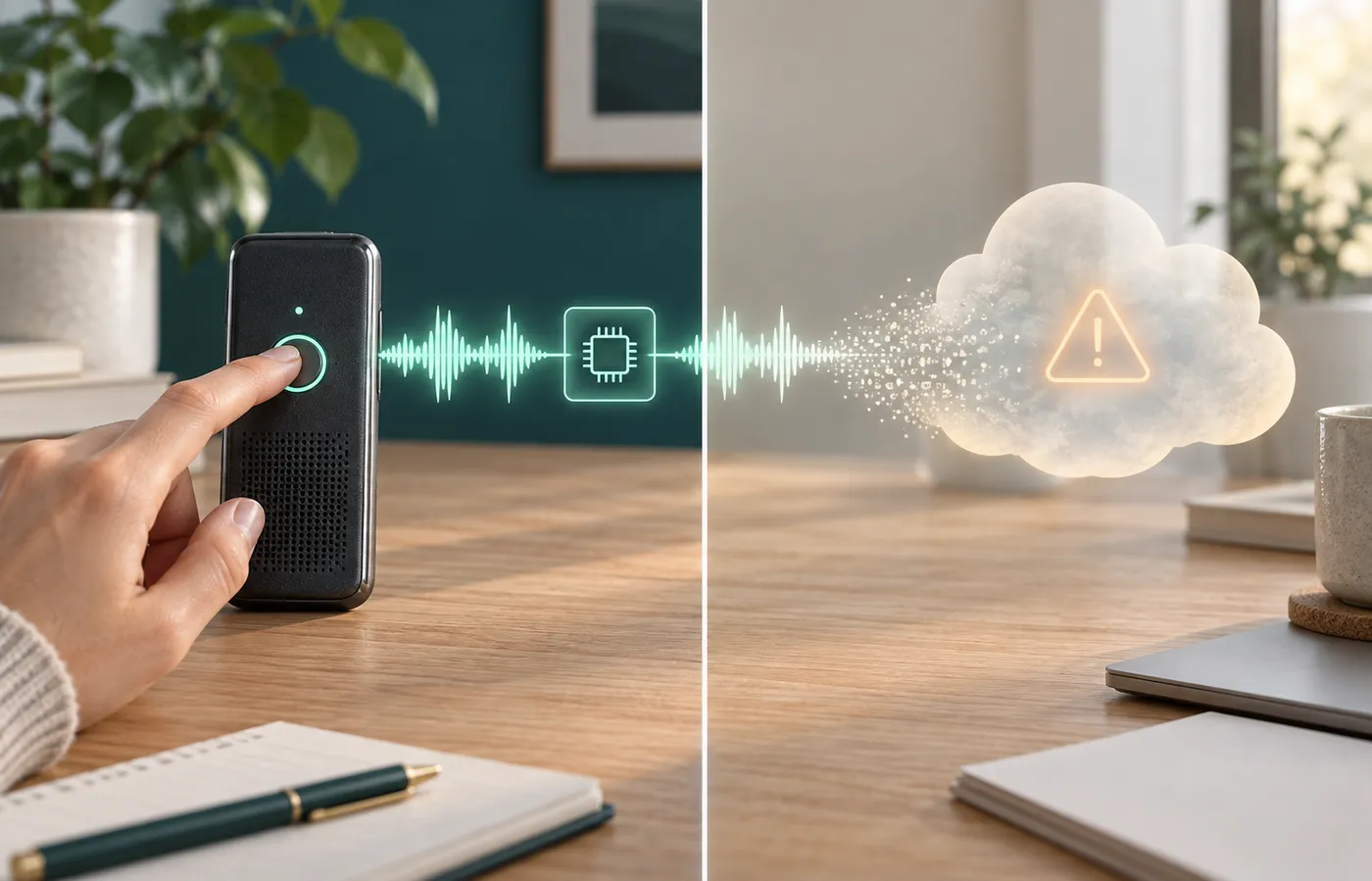
Recording is local on every device we track; transcription is the fork. Cloud devices upload audio to company servers — PLAUD's support docs name server regions in the US, Germany, Japan, or Singapore [SPEC via support docs], and state that no persistent copy remains after transcription when cloud sync is off. That is a meaningful commitment — and still a categorically different promise from "the audio never left the device."
For privileged conversations, the conservative posture is simple: capture offline, or capture on any device and transcribe locally with software you control. The trade-offs live in our local-vs-cloud transcription guide; the device-by-device map is in our privacy teardown. Vendor mortality is part of the math too — the Limitless Pendant was discontinued in December 2025, a reminder that transcripts can outlive the company holding them. PLAUD advertises ISO 27001, SOC 2, and HIPAA compliance; certifications matter for procurement, but they are not the same as keeping audio local.
Consent: all-party versus one-party
US call recording follows a federal one-party default; roughly a dozen states require every participant's consent, with California's Penal Code §632 the canonical example [per our consent-law guide]. In-person recording turns on a reasonable expectation of privacy — a loud public café is not a conference room, and a lawyer's office is the opposite end of that spectrum: assume the stricter reading. Calls cross state lines invisibly — the conservative practice is to satisfy the stricter rule wherever the other party may sit — and firm policies stack on top of state law. The disclosure line — "Mind if I record this for our notes?" — converts a legal question into a yes/no. This is education, not legal advice; the Justia 50-state survey and the RCFP Reporter's Recording Guide are the references, and our consent-law guide translates the framework without the jargon.
Call recording: what the hardware can and cannot do
iOS restricts call-recording apps, which is why hardware capture methods matter. The PLAUD Note captures calls through its magnetic vibration-sensor case; the Note Pro detects phone-attached mode automatically; TicNote is placement-only; the SR302 Pro does not capture calls at all. Consent rules for calls are stricter in practice — federal and state layers stack — and our phone-call guide covers the mechanics and the rulebook.
Capture distance: the desk versus the deposition room
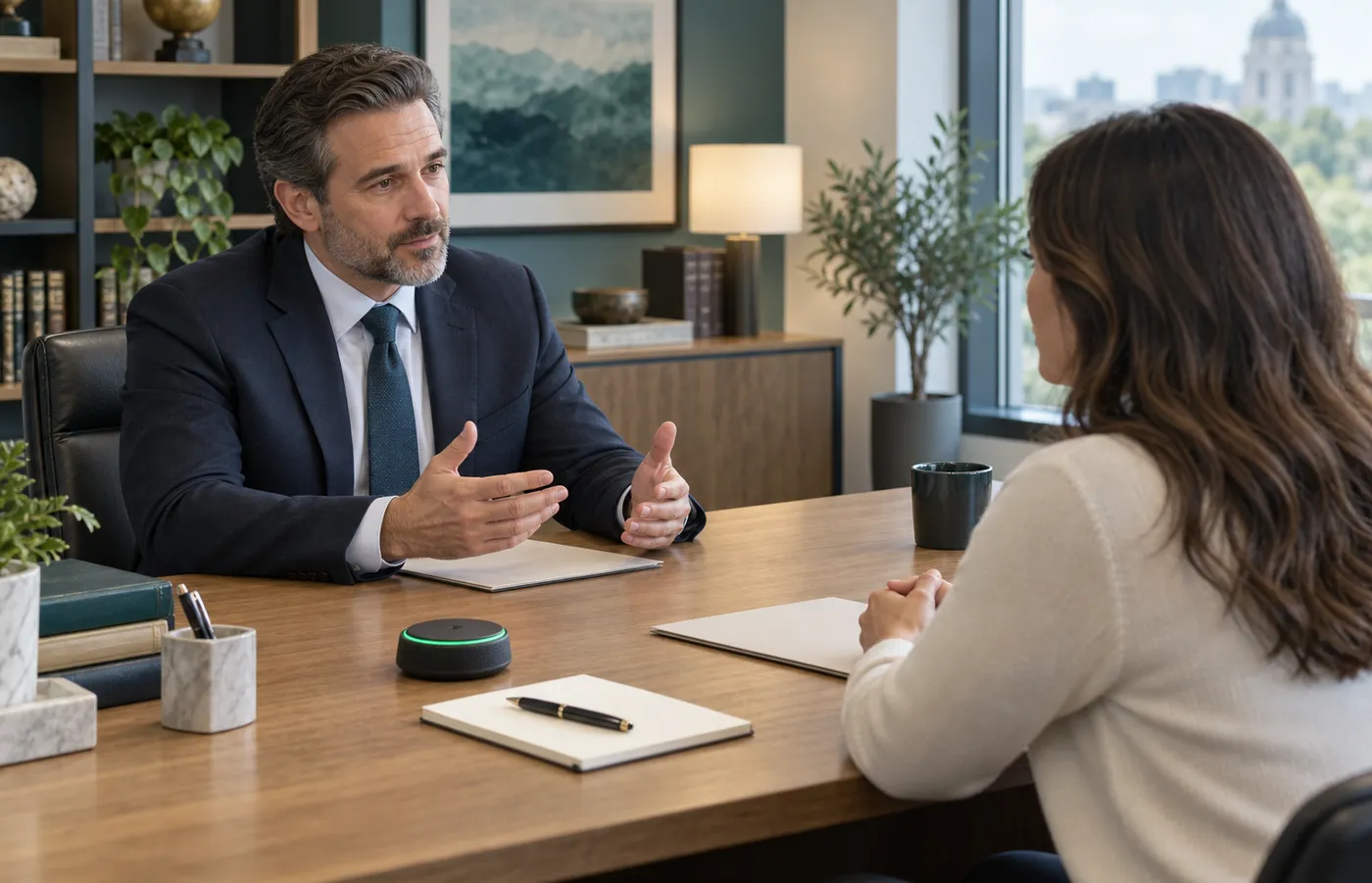
A two-person consultation across a desk is easy duty: put the recorder on the table, closer to the client. Conference tables and deposition-style rooms are where accuracy dies, because distance — not the AI model — causes most transcription failures. Maker range claims are ceilings; plan around 2–3 meters in a quiet room, and halve the distance before you shop for a bigger microphone array. Speaker labels deserve the same skepticism: owner reports commonly flag mislabeling in crosstalk, so verify attribution before anything enters a memo — our speaker-identification explainer covers why.
Transcription volume: the economics that pick the device
Deposition and discovery volume is where free tiers break. PLAUD includes 300 free minutes a month, TicNote 600, and the SR302 Pro transcribes unlimited minutes on-device with no subscription. Measure a real month with our transcription minutes calculator, then price the 3-year total in our TCO study — where the Note Pro carries the heaviest total in our dataset and the offline device carries none.
Practical guidance
The four picks, side by side
| Pick | Form factor | Call capture | Cloud posture | Free tier |
|---|---|---|---|---|
| PLAUD Note Pro | Card | Yes — automatic dual-mode detection | Cloud — US/DE/JP/SG servers | 300 min/mo |
| PLAUD Note | Card | Yes — magnetic-case vibration sensor | Cloud — same regions | 300 min/mo |
| iFLYTEK SR302 Pro | Handheld | No | Fully local — on-device transcription | Unlimited, on-device |
| TicNote | Card | Placement-only | Cloud | 600 min/mo |
FAQ
Frequently asked questions
Is it ethical for a lawyer to record a client or opposing party?
Can an AI transcript be used for a deposition or in court?
Which recorder keeps privileged audio off the cloud entirely?
How many transcription minutes does a solo practice need?
Do I need call recording, or is in-person capture enough?
Is a cloud recorder's compliance certification enough for client data?
Keep reading
Recording consent laws, explained
One-party and all-party states, and what the person holding the recorder owes everyone else.
Best AI recorders for journalists
The field's highest transcription volume — endurance and pickup-distance picks.
AI recorder privacy architecture
What each device uploads, what stays local, and why it matters for privileged work.