On this page
The SERP for “AI voice recorder for journalists” is a time capsule: Reddit threads from 2022 recommending the Sony ICD-PX370, Wirecutter’s long-standing non-AI pick (the Sony UX560), and Philips dictation pages. Meanwhile the actual journalistic questions of 2026 — can a cloud AI recorder burn a confidential source? what does a newsroom standard for disclosure look like? — have almost no independent coverage.
Related: editorial policy.
This guide frames the decision the way newsrooms do: source protection first, speed second, cost third. No hands-on testing claims — every claim is [SPEC], [REVIEW], or [OWNER] evidence, and we name the trade-offs as plainly as the benefits.
 Field reporting
The short answer
iFLYTEK SR302 Pro for sensitive sources · PLAUD Note for daily reporting speed
Deadline workflow: PLAUD Note — ChatGPT MCP server pulls transcripts directly [SPEC]
No cloud at all: Any legacy recorder + local transcription software — see the frame below
The frame
Source protection is the frame
Every AI recorder in this guide except one uploads audio to company servers for transcription. PLAUD’s own documentation is unusually clear about the pipeline: recordings stay on the device by default, but transcription processes on PLAUD servers located in the US, Germany, Japan, or Singapore depending on region [SPEC]. That’s fine for a press conference. It’s a category error for a whistleblower interview — subpoena risk, breach risk, and source-relations risk all live in that upload.
The offline exception is the iFLYTEK SR302 Pro: transcription runs on the device itself, in five languages, with no account required [SPEC]. It is the only mainstream hardware where the source-protection question has a clean answer. The deeper version of this analysis — retention, regional servers, GDPR — lives in where your recordings actually go and local vs cloud transcription.
Method
How we picked
We order picks the way a newsroom weighs risk: source protection first — where audio and transcripts live, and whether processing can be avoided entirely — capture reliability and turnaround second, cost last. Two devices cover two threat models: fully offline with no account, or cloud speed with explicit disclosure. All evidence is [SPEC]/[REVIEW]/[OWNER] per our methodology; we never claim hands-on testing, and we name the incumbent (the Sony UX560) where it still holds.
Not for: reporters whose sources consent freely and whose deadlines favor cloud speed — this page optimizes for the source-protection end of the job.
The picks
Two devices, two threat models
iFLYTEK
Smart Recorder SR302 Pro
Handheld recorder that transcribes on-device — no cloud, no account, no subscription.
Why this pick
The only mainstream recorder that transcribes on-device — no account, no cloud, no subscription [SPEC]. For confidential-source interviews, legal-privilege conversations, and any story where the audio itself is the risk, it removes the upload from the pipeline entirely. Trade-offs a journalist should weigh honestly: English accuracy trails cloud leaders and struggles with accents [REVIEW]; the 99.6 g handheld reads as 'recorder' in a room, which can matter for optics.
- Observed retail*
- $128–$249
- Free minutes
- Unlimited
- Transcription
- local
- Phone calls
- No
- The only mainstream recorder that transcribes entirely on-device
- $0 subscription, ever — lowest total cost in the category
- Traditional handheld form factor with a screen and physical controls
- English accuracy trails cloud leaders per third-party reviews — struggles with accents
- Bulkiest form factor here — not pocket-invisible
- Skip if your deadline workflow needs cloud speed and integrations — fully offline is the point, and the price
*Observed retail price is editorial research dated August 2026, not a live Amazon price. Verify current price, seller, warranty, and availability before purchase.
Keep reading
PLAUD
PLAUD Note
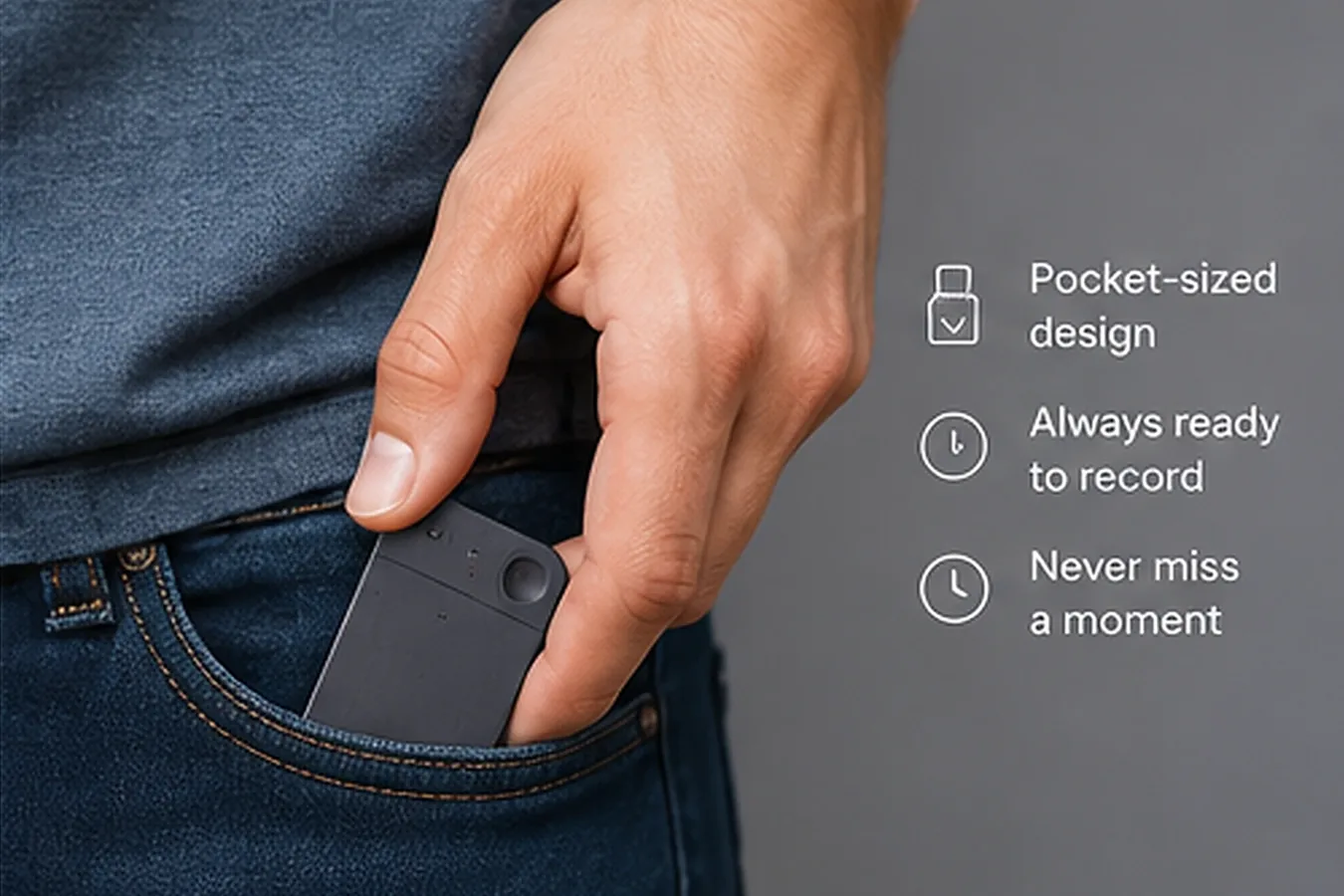
The category-defining card recorder that rides on the back of your phone.
Why this pick
On-record work is a speed game, and the Note is the fastest path from audio to filed copy: speaker-labeled transcripts, GPT summaries, native Notion export, Zapier, and an MCP server that lets ChatGPT query your transcripts directly [SPEC]. The wallet-thin card is unobtrusive at pressers. Caveats: cloud-only transcription (see the frame above), 300 free min/mo before $99.99/yr Pro, and owner-reported speaker-label errors in crosstalk [OWNER] — proofread attribution before publication.
- Observed retail*
- $129–$159
- Free minutes
- 300 min/mo
- Transcription
- cloud
- Phone calls
- Yes
- Thinnest card format in the category — genuinely wallet-able
- Best-known call-recording workaround for iPhone via the magnetic case
- Mature app: speaker labels, summaries, Notion + ChatGPT export
- Only 300 free transcription minutes/month; Unlimited costs $239.99/yr
- Cloud-only transcription — no offline option
- Skip if source protection forbids cloud processing — audio is processed on PLAUD servers in the US, Germany, Japan, or Singapore [SPEC]
⚠ PLAUD's Trustpilot sits at 4.7/5 from 2,000+ reviews as of August 2026, per the brand's own site (live page: trustpilot.com/review/plaud.ai), but Reddit contains recurring complaints about subscription value, speaker labels, and support. Weigh both.
*Observed retail price is editorial research dated August 2026, not a live Amazon price. Verify current price, seller, warranty, and availability before purchase.
Context
What the 2022-era guides still recommend
The incumbent advice — Sony’s ICD-PX370 (r/Journalism, 2022) and Wirecutter’s Sony UX560 pick — remains genuinely defensible for one reason: no cloud, ever. A legacy recorder captures audio to internal memory, full stop. What it doesn’t do is transcribe: you’re back to typing, or to feeding files into transcription software separately.
The 2026 synthesis: legacy hardware plus locally-run transcription software is the DIY version of what iFLYTEK ships built-in. If your newsroom already has a local-Whisper workflow, a dumb recorder is arguably the more flexible head of that pipeline. If it doesn’t, the SR302 Pro bundles the same philosophy in one device.
Speed
The deadline workflow
- Capture with disclosure. Consent on the record — state law (one-party vs all-party) plus newsroom standard; the map is in recording consent laws, and the RCFP’s Reporter’s Recording Guide remains the professional reference.
- Transcribe on deadline (on-record work). Cloud turnaround on an hour-long interview is minutes, not hours — the Note’s summaries give you the nut graf while you write.
- Export into your drafts. Notion export, Zapier, or the ChatGPT MCP server [SPEC]; the wire-to-draft path matters more than any single transcript feature. Every option is cataloged in exports & integrations.
- Verify quotes against audio. Non-negotiable given owner-reported label errors [OWNER]. AI transcripts are drafts, not records.
Interview-specific capture advice — two voices, table placement, label accuracy — is its own page: best AI recorders for interviews.
The two picks, side by side
| Spec | Smart Recorder SR302 Pro | PLAUD Note |
|---|---|---|
| Price (editorial, Aug 2026) | $128–$249 | $129–$159 |
| Free minutes/mo | Unlimited — on-device [SPEC] | 300 min/mo [SPEC] |
| Transcription mode | Local — no cloud, no account [SPEC] | Cloud [SPEC] |
| Phone calls | No | Yes — case-based capture [SPEC] |
*Observed retail price is editorial research dated August 2026, not a live Amazon price. Verify current price, seller, warranty, and availability before purchase.
Warranty at a glance
Warranty at a glance: Smart Recorder SR302 Pro — 1 year [SPEC] (store.iflytek.com, Sep 2026); PLAUD Note — 12 months from delivery [SPEC] (plaud.ai, Sep 2026).
FAQ