On this page
AI Recorder Mic Distance 101: How Far Is Too Far
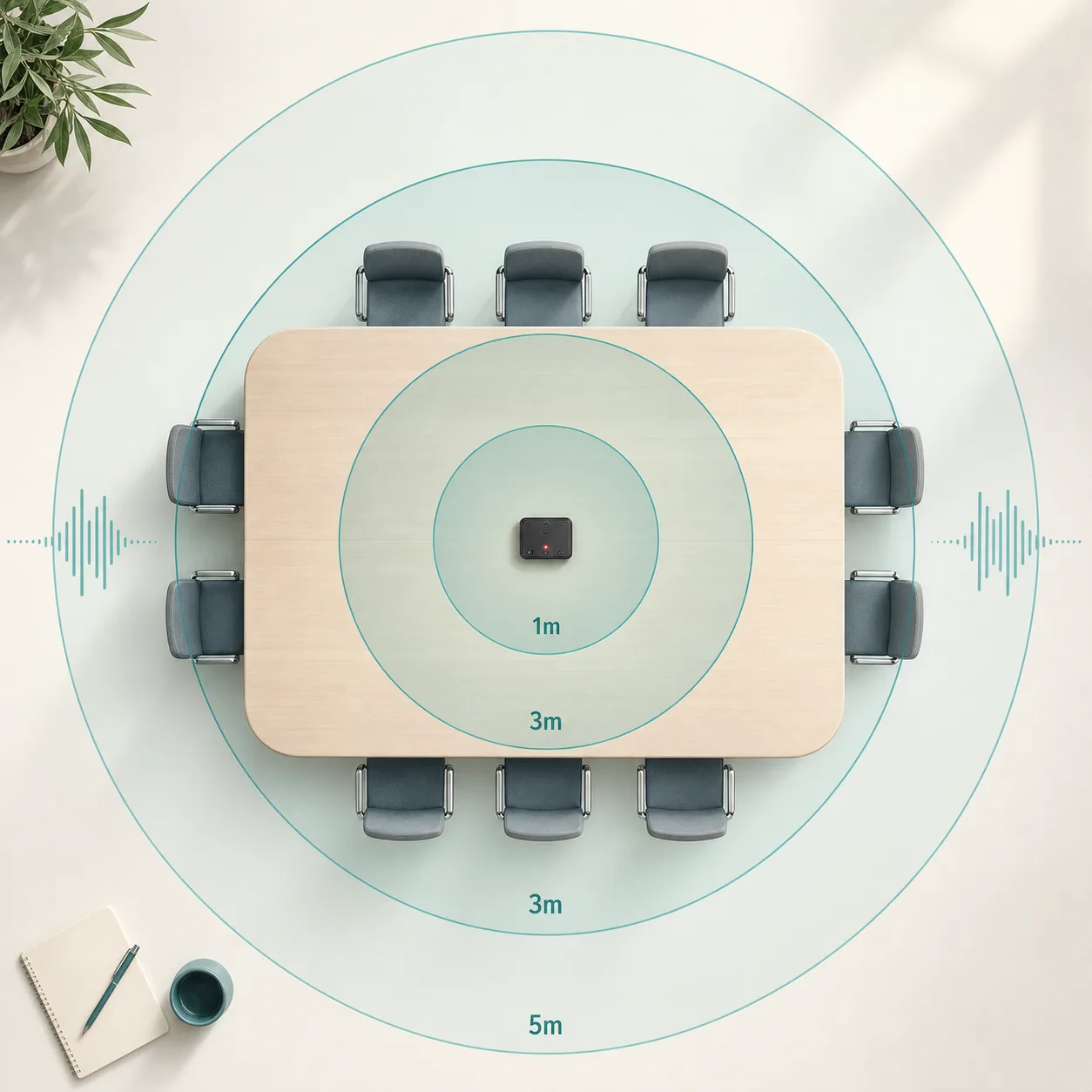
The short answer: plan around 2–3 meters in a quiet room — that's the honest working range even for devices advertising 10 m or 16.4 ft. Distance claims are marketing ceilings; PLAUD's own lecture blog deflates them to "2 to 3 meters." Halving the distance beats doubling the microphone array every time. Below: the per-device claims table, the physics, and a placement playbook that fixes more transcripts than any spec upgrade.
Guide
The distance table
Every figure below is the maker's own published claim, verified from the register 2026-09-06. We did not test any of them. The claim-type column tells you where the number lives — spec-sheet (product/FAQ page), blog (marketing content), support-guidance (help docs), or no-published-figure. That distinction matters: a spec-sheet figure and a support-doc figure can describe the same mic and disagree, because they measure different conditions.
| Device | Maker's quoted claim | Claim type | Reality anchor (see physics) |
|---|---|---|---|
| PLAUD Note Pro | "It captures voices up to 16.4 ft with 4 MEMS and 1 VPU microphones" | Spec-sheet (product page, plaud.ai) | ~5 m ceiling in a quiet room; 2× the base Note's array |
| soundcore Work (D3200) | "16.4 ft" (pickup range, dual mics) | Spec-sheet (official FAQ, soundcore.com) | Same ~5 m ceiling; matches Note Pro on paper |
| TicNote | "Recording Range: 10m"; "Microphone Type: 3MEMS microphones" | Spec-sheet (product page, ticnote.ai) | 10 m is the marketing figure; support guidance says optimal 3–5 m, 5 m for conferences |
| NOTTA Memo | "up to 10 feet (~3 m)" | Spec-sheet (official store, shop.notta.ai) | 4 MEMS + 1 bone-conduction mic |
| PLAUD Note | "Up to 9.8 feet" | Spec-sheet (product page, plaud.ai) | 2 MEMS + 1 VPU; owners report it works best close to the speaker |
| HiDock P1 | "3 m (10 ft)" own-mic, per Setup Guide — and "up to 16.4 ft" in a beamforming comparison | 3 m = support-guidance (Setup Guide); 16.4 ft = blog claim | Treat 3 m as the working figure; 16.4 ft is beamforming-mode marketing |
| PLAUD NotePin S | (no range number published) | Support-guidance: PLAUD guidance says 0.3–1.5 m best / 1.5–3 m good | Wearable — the guidance is explicit because placement is the whole design |
| No published meter figure | No published figure (2 studio mics) | "2 studio mics" only; no distance number to hold them to |
Guide
Why distance claims are measured differently
The short version: every maker measures range in a different room, and the number you get depends entirely on which room.
- Quiet room: a controlled, mostly empty space with no HVAC, no reverb, one speaker. This is where the headline figures (9.8 ft, 16.4 ft, 10 m) are generated — and where PLAUD's own lecture blog admits pickup "stays at 2 to 3 meters in quiet rooms."
- Conference room: furniture, windows, HVAC hum, multiple speakers, table reflections. Usable range shrinks — often to roughly half the quiet-room number.
- Beamforming mode: several devices (HiDock's blog, the Note Pro's array) can electronically steer toward one talker, which extends useful range in one direction while ignoring the room. That's how you get a "16.4 ft" blog claim that the setup guide won't repeat as a general figure.
- Support-guidance vs spec-sheet: the spec-sheet number is the aspirational ceiling; the support doc is the figure the maker will actually stand behind for everyday use. Where they disagree (TicNote, HiDock), the support figure is the honest one to plan around.
Guardrail note: compatibility with specific online meeting apps (e.g., meeting apps) is our editorial analysis, not a maker claim — no maker page we verified names a specific meeting app. See our dedicated compatibility analysis.
Guide
The physics in plain English
Inverse square law: sound energy falls off as the square of distance. Double the distance from 1 m to 2 m and the voice reaches the mic at roughly one-quarter the strength. That is why "half the distance" outperforms "twice the microphones": halving distance quadruples the signal, while adding mics mainly improves direction and noise rejection.
Signal-to-noise ratio (SNR): the transcript is only as good as the voice's strength relative to room noise. Move the recorder from 1 m to 3 m and the voice drops by ~10 dB while the HVAC stays constant — so the SNR collapses, and no transcription model can rebuild the words that were buried in the noise floor. This is the single biggest driver of accuracy failure in the category.
Why closer beats farther for transcription: the AI model is trained on clean, close speech. A recorder 1–2 meters from the speaker with modest mics will out-transcribe a cutting-edge model fed from across a lecture hall. Placement is free; distance is expensive. Reverb (sound bouncing off walls and smearing word boundaries) and crosstalk (competing voices) scale with distance too — every extra meter buys you more of both.
Guide
Per-form-factor guidance
- Card on the table (PLAUD Note/Note Pro, soundcore Work, TicNote, Notta Memo, HiDock): a card recorder lying flat on a table points at the ceiling, not at the speaker — one of the worst possible placements for a directional mic. Prop it on its edge, angle the front toward the talker, or move it to the speaker's side of the table. A card 1–2 m from the speaker beats a card 5 m away regardless of spec.
- Wearable on the wrist or clipped (PLAUD NotePin/NotePin S, Bee-type wristband): the whole design is proximity — PLAUD's own guidance puts NotePin S's best zone at 0.3–1.5 m, good out to 1.5–3 m. A wearable on the asker's side of the room beats a better card for capturing questions, because it rides within a meter or two of whoever speaks.
- Earphone-capture (HiDock's BlueCatch-style approach): the most extreme proximity play — the mic rides on the person wearing earphones, so range is effectively irrelevant for that talker. Trade-off: it captures the wearer's side of a call, not the whole room.
Guide
The placement playbook
PLAUD's own lecture-hall blog is our reality anchor: "pickup range stays at 2 to 3 meters in quiet rooms." That's the maker themselves deflating the headline spec. Use it as your working number and apply these steps, in order of effectiveness:
- Sit closer. Halving the distance to the speaker does more for accuracy than doubling the microphone array.
- Put the recorder up front. Instructors who permit recording usually permit placement near the lectern — ask, and get consent on the record while you're at it (see consent laws).
- Aim the mics. A card recorder has a front; point it at the speaker, not at the ceiling.
- Watch the angle, not just the distance. A recorder 3 m away facing the talker beats one 1.5 m away aimed away from them.
- Handle crosstalk. Q&A from the back is the hardest capture in the category. If questions matter, a wearable on the asker's side of the room beats a better card across the room.
- Use the smaller published number. When a maker lists two figures (TicNote 10 m vs 3–5 m; HiDock 16.4 ft vs 3 m), plan around the support-guidance figure.
Guide
When a dedicated mic setup beats moving the recorder
Sometimes placement can't save you — and that's when a separate microphone beats any card.
- Lecture halls and theaters where you physically cannot get within 3 m: a handheld recorder or an external mic placed at the lectern (with permission) captures what a card in your lap never will.
- Fixed seating (assigned theater rows, front of a conference table): you can't "just sit closer," so an external mic in the room is the honest fix.
- Crosstalk-heavy rooms (roundtable, panel Q&A): one recorder in the middle captures everyone poorly; a mic per speaker or a wearable on the active speaker captures each cleanly.
- Professional interviews where quote accuracy matters: a recorder at 1–2 m or a lapel/headset mic removes the SNR gamble entirely. See our interviews guide.
- Rule of thumb (editorial assessment): if the quiet-room 2–3 m rule doesn't fit your room, don't buy a longer-range card — change the capture point. A cheap lapel mic and better placement beat a spec-sheet number every time.
---
If you sit near the front (≤3 m from the speaker): your room isn't "big" for capture purposes. A base PLAUD Note (9.8 ft spec, 2 MEMS + VPU) is adequate per owners — placement is doing the work. Save the money. If you cannot sit near the speaker: the mic-range story is what you're buying. PLAUD Note Pro quotes 16.4 ft (4 MEMS + VPU) and is the only card in the category that advertises a distance story. It's the pick for big halls where a better array buys seating freedom. If you want the free-tier math instead of the flagship: TicNote quotes 10 m and pairs it with 600 free transcription minutes/month — but its own guidance says 3–5 m optimal. On a big-room budget it's the value route, with the honest caveat that its support figure is closer to the field's.
---
FAQ