On this page
If you searched for “TicNote review” and landed here, you have already noticed something odd: nearly everything that ranks is written by TicNote’s parent company. Mobvoi publishes the product pages, its own comparison posts, and the app-store presence — while independent outlets have barely touched the device. That is exactly why this page exists. This is our evidence synthesis: what the manufacturer claims [SPEC], what the numbers in our total-cost-of-ownership study say, and a plain account of what nobody can honestly tell you yet.
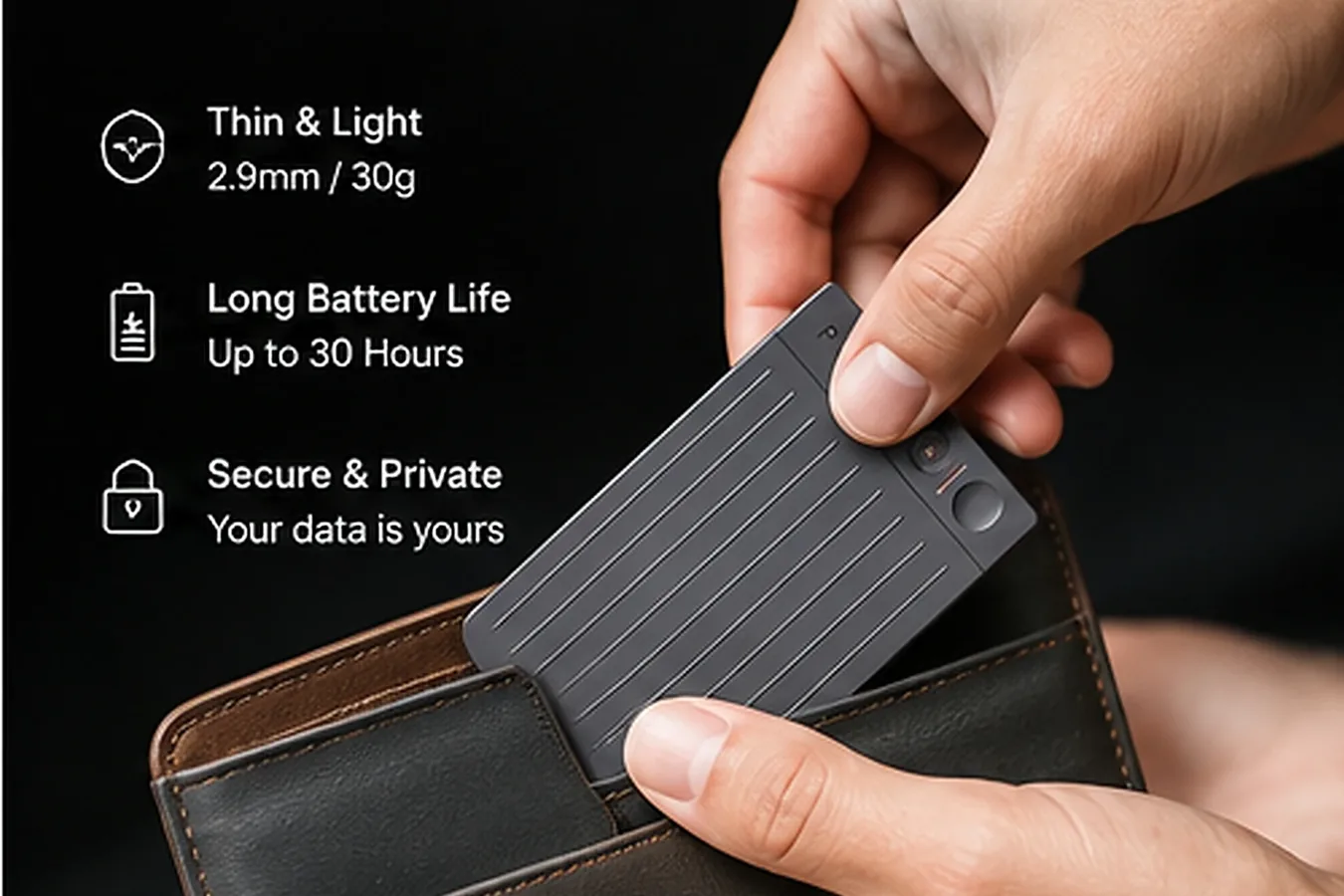 Card recorder illustration
The short answer
Best value in the category on our dataset — if you accept a young ecosystem and cloud-only transcription
600 min/mo free transcription — largest tier we track
$79/yr Pro — cheapest paid plan in the category
$336 3-year total at the low end of street pricing
VS PLAUD 600 vs 300 free min; $79 vs $99.99 Pro
Three rules before you export anything
- Export early, not at exit. Several owners discover format limits only when leaving — run one real export in week one [EDIT, consistent with the owner threads we track].
- Distinguish audio from transcripts. Raw audio is nearly always downloadable; the AI artifacts (summaries, speaker labels, mind maps) are where ecosystems differ [EDIT].
- Check the deletion path too. Portability out and erasure are different menu items — privacy-conscious owners should verify both (see the privacy guide).
Per device: what the manufacturers publish
PLAUD (Note, Note Pro, NotePin, NotePin S).
Notion, ChatGPT (MCP server), Zapier, Dropbox integrations [SPEC, plaud.ai Sep 2026] — the deepest export surface in the category. Audio and transcripts export through the app; the MCP route lets external tools query your transcripts directly [SPEC]. The integrations map: our exports & integrations guide.
Notta Memo.
One-click share “to hundreds of platforms, including Slack and Salesforce” [SPEC, shop.notta.ai Sep 2026]; direct PC connection exists specifically for offline/confidential data management [SPEC]. Note the split: Notta’s export strength is app-side; the hardware records locally like the others.
TicNote.
App-based exports with live on-screen transcription during capture [OWNER]; 64 GB on-device storage (~434 hours) gives a large local buffer before anything must move [SPEC]. Brand-specific export format documentation was not machine-retrievable at research time (ticnote.ai help center, 2026-09-05) — verify current formats in-app before relying on a workflow.
HiDock P1.
Integrations “not documented on manufacturer pages” as of Sep 2026 [SPEC, verified on hidock.com] — the honest answer is that export surface is currently undefined in public docs; local recordings are the guaranteed portable asset. This is the trade the HiDock review prices.
iFLYTEK SR302 Pro.
On-device transcription with no account [SPEC] — the data never had to leave, so portability is physical: the device, its storage, and whatever file transfer it supports. The most lock-in-resistant architecture in the field, at the documented cost of cloud-grade English accuracy [REVIEW].
What exports as what (verified claims only)
| Device | Raw audio | Transcripts | Integrations | Verified |
|---|---|---|---|---|
| PLAUD family | App download | App export + Notion/Zapier/Dropbox | Notion, ChatGPT (MCP), Zapier, Dropbox | [SPEC] Sep 2026 |
| Notta Memo | Local + app | Share to Slack/Salesforce; PC connection | Slack, Salesforce, calendar | [SPEC] Sep 2026 |
| TicNote | On-device (64 GB) | App export | Ecosystem young [EDIT] | [SPEC]/[OWNER] Sep 2026 |
| HiDock P1 | On-device | Not publicly documented | Not documented [SPEC] | [SPEC] Sep 2026 |
| SR302 Pro | On-device | On-device (no account) | None needed (offline) | [SPEC] Aug 2026 |
Cells say “not documented” where the manufacturer publishes nothing — that is a finding, not an oversight. Exact audio codecs per device were not uniformly machine-verifiable (help centers blocked 2026-09-05); verify in-app before building a workflow on a specific format.
Where the lock-in actually lives
Not in the audio — every device keeps local recordings. The lock-in is the AI layer: summaries, speaker labels, templates, and search live in each ecosystem’s cloud, and their export formats are the least standardized [EDIT]. If your notes must outlive your subscription, plan the transcript pipeline (Notion via Zapier, MCP queries, scheduled exports) from day one — the cancellation guide covers the leaving end of the same journey.
FAQ
Frequently asked questions
Can I export my audio without a subscription?
Which ecosystem exports best?
What about deleting my data entirely?
Research sources
Service guide — evidence synthesis per our review methodology. [OWNER] owner reports (Reddit communities, dated) · [SPEC] manufacturer pages (dated) · [EDIT] our analysis. No hands-on testing claims. Updated September 2026.